

Emotional Self-Mastery
Emotions are gold. Like buried treasure, the value of an emotion is realized when we uncover it and bring it to light rather than leave it buried. If we don’t consciously work with our emotions, our emotions will unconsciously work on us.
To be conscious of our emotions is to be aware of them, allow them to be, and intentionally invite them to inform us with the messages they have for us. That’s emotional self-mastery.
The POP Quiz (Pause, Observe, Pivot, Question) framework is a potent self-mastery tool to shift a challenging emotion into a self-empowered moment for conscious choice. Let’s look at the tool and apply it to a couple of emotions.
The Tool: POP Quiz (Pause, Observe, Pivot, Question)
When an emotion arises:
- Pause first and breathe. Breathe. Breathe. Breathe. A full breath in and a full breath out. Repeat. Don’t forget to breathe out. I spent half my career holding my breath in!
- Observe. Be present with the emotion. Allow it to be without judgment. Where is this emotion in your body? State, “My body is experiencing (fill in the blank with the emotion you feel). Even though I feel (emotion), I love and respect myself.” It’s important not to own the emotion, as in “I am afraid, jealous, anxious, etc.,” but rather to observe it as a sensation.
- Pivot towards the emotion, acknowledge it, and thank it. “I see you, (emotion). Thank you for showing up to teach me something I need to know.” That’s right—bring in gratitude. Gratitude is a high vibration that softens any resistance to having the emotion.
- Question. Ask the emotion, “Why are you here? What do you have to tell me? What do you want me to know? Do you (emotion) have a message for me? What is a step I can take to intentionally address the concern in this moment?”
The Tool Applied to Fear, Jealousy, and Anxiety
Fear Alerts Us to Danger and Helps Us Notice What Really Matters
Fear acts as an early warning system to alert us to potential danger or loss, and at the same time, signals what really matters to us that we want to protect or preserve.
I’m in a meeting, and my assistant sticks her head in the room. “Sorry to interrupt, but the boss wants you to call her now.”
“Do you know what it’s about?”
“No, they didn’t say.”
My heartbeat picks up, and I can feel my face flush. “Thanks, I’ll be right there.”
Am I in trouble? As I’m walking to my office, I’m inventorying. What did I do? What didn’t I do?
I’m picturing potential scenarios where I’ll be blamed, shamed, or punished as my breathing increases.
I pick up the phone to call and realize I can’t quite catch my breath. Fear is having its way with me.
[Pause.] Pause. Breathe. Deep breath in and out. Slow it down.
[Observe.] My body is experiencing fear. Even though I’m experiencing fear, I love and respect myself.
[Pivot.] I see you, fear. Thank you for showing up to teach me something important for me to know.
[Question.] Fear, what do you have to tell me?
Fear: I’m alerting you to scenarios where your self-worth could be diminished by an external voice. Your sense of competence and value matter to you.
[Question.] What step can I take to immediately address this concern?
Fear: You can move into curiosity. It will be interesting to see what’s on her mind. What problem may need to be solved? What idea may need to be communicated? What accomplishment may need to be acknowledged? You ask excellent questions and listen well.
I punched in the numbers and calmly called my boss, prepared to ask questions, listen, and respond.
Jealousy Points Out Something We Want for Ourselves
Jealousy is a signpost for what we value, and it’s a great tool at work or in our personal lives to help us sift through what we want for ourselves.
I’m in a women’s circle retreat, and a fellow participant shares a potent insight after a meditative journey exercise.
Why is it so easy for her? I didn’t get anything even close to what she got. Why can’t I have those vivid visions and clear messages? I want what she has.
I shake my head to clear it. My jealousy meter is registering “green.”
[Pause] Pause. Breathe. Deep breath in and out.
[Observe] My body is experiencing jealousy. Even though I’m experiencing jealousy, I love and respect myself.
[Pivot] I see you, jealousy. Thank you for showing up to teach me something important for me to know.
[Question] Jealousy, why are you here?
Jealousy: You are longing for something you believe someone else has that you don’t. What is it that you want for yourself?
I’d like for it to be easy to channel visions from other realms that uplift others.
[Question] What step can I take to begin to have this for myself?
Jealousy: This longing is not quite as straightforward as ‘I’d like to be in good shape with lots of energy.’ We need to tease out the desire that sits underneath the longing. How do you want to feel?
I want to feel like I’ve connected with something bigger than myself and that that connection has an impact for others in a positive way.
Jealousy: Have you ever experienced something like that feeling?
I thought about that question while imagining the feeling. Then the answer popped up. Oh! When I sing!
Jealousy: You know how easy it is for you to sing and inspire and move people? To pick up a tune and to draw others in through the power of your voice? And when people compliment you, you assure them that it’s a gift, so you can’t take any credit except for showing up? Would you trade the gift of your voice for the ability to “hear” easily from the other realms?”
Ahhhhhhhh, no!
Jealousy: So, what do you want for yourself?
To connect with the higher realms and channel inspiration for others through singing.
I thanked my fellow participant for sharing her gift and joined a circle singing group to share mine.
Anxiety Shows Us Where We Are Out of Balance
Anxiety points the way to where we are out of balance, caught up in the nervous energy of anticipatory dread. To break the cycle, catch the thought bubble of the future downside scenario and then write or talk out its opposite positive outcome. This is a scenario planning tool that can be applied personally or to a business situation that is generating anxiety.
When traveling overseas, I was checking in for my flight online, and the form was in Spanish. Having filled out a few other Spanish travel forms, I assumed that my last name went first on the form and then my second name.
Nope. Ah-oh.
The boarding pass got issued to Jill, Austin vs. Austin, Jill. Suddenly I had a new last name and a case of anxiety. Will I be found out? Will they let me on the flight? Will I be singled out for interrogation? In Spanish? Will I miss my pickup on the other end of the flight and be stranded in a foreign country? Maybe if I can picture the worst that can happen, I can solve for it and calm myself down.
I started pacing in circles. What’s the worst that could happen? What’s the worst that could happen? What’s the worst that could happen?
Absorbed in my “what could go wrong” litany, I bumped into a fellow passenger, breaking my concentration. I realized I was literally talking myself in circles, caught up in a whirlpool of anxiety.
[Pause] Pause. Breathe. Deep breath in and out.
[Observe] My body is experiencing anxiety. Even though I’m experiencing anxiety, I love and respect myself.
[Pivot] I see you, anxiety. Thank you for showing up to teach me something important for me to know.
[Question] Anxiety, what message do you have for me?
Anxiety: You’re out of balance, leaning way over into the future dread of anticipating something bad. You’re off center.
[Question] What can I do right now about that?
Anxiety: Ask yourself, ‘What’s the best that could happen?’ to counterbalance the worst scenario. That will support you in calming down and eventually in returning to the present moment instead of dwelling in the future.
I started picturing a smooth ticket encounter with the gate agent and returned to that picture when I felt myself go out of balance into anxiety. Soon I was able to recognize I was thirsty and asked a fellow traveler if they wanted to go get tea.
And guess what? I got on the plane without a hiccup.
Additional Uses for POP Quiz
We’ve covered three scenarios applying POP Quiz to the emotions of fear, jealousy, and anxiety. In addition to other emotions, POP Quiz can be applied to inner dialogue and actions for self-mastery. The following tables provide ideas for translating the signals of emotions, inner dialogue, and actions into helpful messages.
Possible Translations for Emotions
-
- Fear = What matters to me? What do I want to protect?
- Jealousy = What is it I’d like for myself?
- Anxiety = Where am I out of balance?
- Anger = Where am I not standing in my power?
- Grief = What needs to be integrated from my loss?
- Guilt = Where am I judging myself for my actions?
- Shame = Where do I think I’m a bad person for my actions?
- Resentment = Where am I holding on to what ‘should’ be?
- Resistance = Where am I uncomfortable? Here’s my learning edge.
Possible Translations for Inner Dialogue
-
- Complaints = Where am I projecting my emotions onto others?
- Judgments = Where am I judging myself? What part of me do I find unacceptable?
- Comparison = Where am I feeling low self-worth?
Possible Translations for Actions
- Attacking = Where do I not feel safe?
- Avoiding (hiding, sleeping, shrinking, disappearing, leaving) = Where do I not feel safe?
Tips and Resources
Additional Ideas
The POP Quiz method is meant to acknowledge emotions and allow them to exist without judgment or without bypassing them.
But what if it’s not possible to fully process or experience the emotion in the moment? At the very least, pause and breathe. If the timing allows, observe what your body is experiencing, and make a note to return to that feeling to finish processing it later.
Tips for a timeout moment while in a group setting include taking a sip of water, asking a question, and making statements such as:
- That’s an interesting point.
- What a great question.
- I’m going to bring that to my team and return with our best thinking.
- I don’t know, and I can find out.
Be patient and kind to yourself while trying on the POP Quiz tool. As with all new approaches, practice is useful to gain skill. I recommend practicing in low-risk mundane situations to build the self-mastery “muscle.”
The POP Quiz method is not meant to replace help from others, including professionals, as appropriate. Processing out loud with a friend, coach, or professional counselor or therapist can support you in getting the most from your experience, including recognizing patterns.
Additional Resources
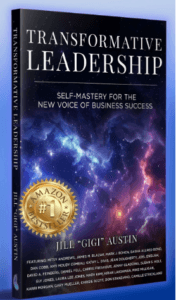
You’ll find other examples of self-mastery tools and applications in the collaborative book, Transformative Leadership: Self-Mastery for the New Voice of Business Success, available on Amazon.
Additional tips and tools are available at: https://www.newvoiceofleadership.com/
Conclusion
Emotional self-mastery involves being aware, present with, and intentional about how we experience and translate emotions into valuable information. Left unacknowledged, emotions can end up running us unconsciously or can store up as uncharged energy in our system and cause bodily dis-ease. Using a tool such as POP Quiz is an approach to mine the gold of insight that emotions offer and move us towards emotional self-mastery.
Connect with Jill on The Wellness Universe and follow her on Facebook and LinkedIn.
The Wellness Universe Wellnesspalooza 2025
Watch Jill Now!
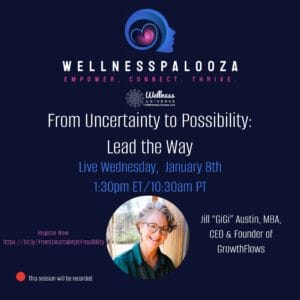
Register Now and Watch the Recording

Over 40 sessions for mind, body, spirit, and financial well-being.
Get the bundle and save! Lifetime Access to the recordings!
https://bit.ly/Wellnesspalooza2025
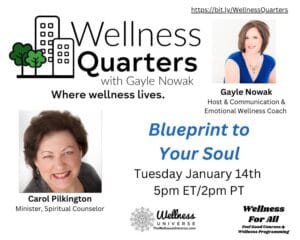
Wellness Quarters with Gayle Nowak
Guest: Carol Pilkinton
Topic: Blueprint to Your Soul
How can astrology guide you and your life? Carol Pilkington explores with us how the ancient system of astrology can help us gain insight into one’s purpose and soul journey.
Register & Join Live: https://bit.ly/WellnessQuarters
The Wellness Universe Guide to Complete Self-Care, 25 Tools for Life will be available January 22, 2025!
Get notified HERE and receive a free book, 25 Tools for Stress Relief.
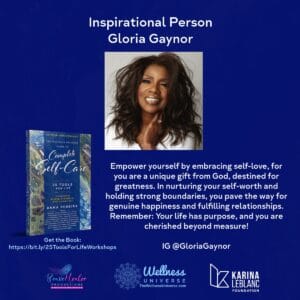
Follow Gloria on Instagram
The Wellness Universe is honored to support our charity of choice, the Karina LeBlanc Foundation. Empowering young women to bring to light their inner greatness.


Jill “GiGi” Austin, MBA, GrowthFlows CEO, and bestselling author, empowers visionaries to elevate their leadership and achieve self-mastery. She fuses business acumen with energy-shifting techniques to propel leaders toward their desired success.
Wow, I loved your “POP Quiz” acronym for these beautiful tools to help us master our emotions, Jill. There is so much “buried treasure” and gold in your article. There are so many helpful questions to ponder and emotions to acknowledge. I learned so much from you. Thank you.