
Some losses arrive with phone calls, hospital rooms, and funerals. Others happen quietly.
A friendship fades until the silence becomes permanent. A long-held dream becomes impossible. An ideal you trusted collapses under the weight of reality. A treasured possession disappears in a fire, during a move, or through one careless moment.
The circumstances may differ, yet each experience can divide life into two parts: before and after.
We usually associate grief with death. In reality, grief begins whenever something meaningful can no longer occupy the place it once held. You may mourn a person, a future, a version of yourself, a home, a career, or the belief that the world works in a certain way.
What hurts is rarely the missing thing alone. Loss takes away the routines, expectations, and identity built around it.
The Brain Has to Learn What the Heart Already Knows
Neuroscientist Mary-Frances O’Connor describes grieving as a form of learning.
The brain constantly creates predictions based on repeated experience: this person will answer the phone, this friendship will continue, this goal will guide my choices, or this object will remain where I left it. After a loss, conscious knowledge may update quickly, while deeper habits and expectations continue operating according to the old reality.
That mismatch explains many strange moments of grief. Your hand reaches for an object that is gone. You begin composing a message to someone who is no longer available. A familiar song briefly returns you to the future you expected to have.
Then reality interrupts, and the loss feels new again.
Research suggests that adaptation requires repeated encounters with absence. The brain must gradually revise its internal map until the new reality becomes part of its expectations (O’Connor & Seeley, 2022). Understanding what happened may take only a few minutes. Absorbing what it means can require months or years.
Loss Lives in the Body
We often speak of grief as though it belongs solely to the heart or the mind. In truth, the entire body mourns.
That is why grief can feel strangely physical. Your limbs become heavy, sleep slips away, your appetite changes, and even the simplest decisions seem to require impossible effort. Some people describe it as moving through water. Others say it feels like carrying an invisible weight that no one else can see. You are not imagining it. Your body is responding to a world that has suddenly become unfamiliar.
Research has shown that profound loss can alter stress hormones such as cortisol, disrupt sleep, increase inflammation, affect immune function, and influence heart rate and blood pressure, particularly during the early months after bereavement (Buckley et al., 2012). These biological changes help explain why grief often brings exhaustion, brain fog, forgetfulness, and a sense that everyday life has become harder than it once was.
Most of this research focuses on the death of a loved one, where the evidence is strongest. Even so, the nervous system does not categorize every loss neatly. The end of a cherished career, the collapse of a lifelong dream, the disappearance of a treasured possession, or the unraveling of a friendship can each dismantle the routines, expectations, and sense of safety that once anchored daily life. Your body responds to disruption long before your mind has finished making sense of it.
Perhaps this is why healing cannot be rushed through willpower alone. A grieving body needs the same compassion we instinctively offer an injured one. Rest is part of recovery. So are nourishing meals, gentle movement, time outdoors, meaningful conversation, and moments of quiet. None of these erase the loss. They simply remind your nervous system, little by little, that although life has changed, it is still safe to keep living.
The Loss of an Idea Can Shake Your Identity
Sometimes an ideal breaks before anything visible changes.
Perhaps you believed hard work would always lead to security. Maybe you trusted a leader, institution, religion, family story, or political cause. New information then made the old belief impossible to maintain.
This kind of loss can feel deeply disorienting because ideas organize our lives. They influence whom we trust, what we consider fair, and how we understand our sacrifices.
Psychologist Crystal Park’s research on meaning-making examines what happens when stressful experiences conflict with a person’s broader beliefs and goals. Distress can emerge from the distance between how we thought life worked and what has actually occurred. Adjustment may involve revising our personal story, finding a different source of purpose, or accepting questions that have no satisfying answers (Park, 2010).
Changing your worldview can feel like betraying your former self. It may instead be evidence that you are responding honestly to experience.
Even Objects Can Carry an Entire Life
A prized possession may look replaceable to everyone else. To you, it might represent a relationship, achievement, home, or period of your life.
The object served as a physical doorway into memory. Once it disappears, you lose the item and the easy access it provided to part of your history.
There may be no public ritual for this kind of grief. People bring food after a funeral, yet few know what to say when someone loses a family photograph, childhood home, wedding ring, manuscript, or handmade gift.
Unrecognized loss can feel especially lonely because the pain receives little permission to exist.
You do not need to exaggerate the object’s value. You also do not have to dismiss your sadness. It mattered because of what it carried.
Healing Does Not Follow a Straight Line
One influential model describes grieving as movement between two forms of coping.
At certain moments, people turn toward the loss by remembering, crying, talking, or trying to understand. During other periods, they focus on restoration by completing responsibilities, forming routines, exploring new roles, or enjoying a temporary break from sorrow.
Healthy coping often involves moving between these experiences rather than permanently remaining in either one (Stroebe & Schut, 1999).
Laughing does not prove that you have forgotten. A painful morning does not erase months of progress. Grief behaves more like a tide than a staircase.
Eventually, loss becomes part of the structure of life. It changes what you notice, what you protect, and what you refuse to postpone. Some people become more cautious. Others grow braver. Many discover that strength is far less dramatic than they imagined. It may simply mean preparing dinner, answering one email, or allowing someone to sit beside them.
Transformation does not make the loss worthwhile. Pain does not need to produce a lesson before it deserves compassion.
Over time, however, a person can become larger around the absence.
The dream may be gone. The friendship may remain unfinished. The ideal may never return. Someone deeply loved may be missing from every future chapter.
Still, life begins forming around the empty space. It does not return to its previous shape. It becomes something else—marked, rearranged, and capable of carrying what was lost alongside everything that remains.
References
- Buckley, T., Sunari, D., Marshall, A., Bartrop, R., McKinley, S., & Tofler, G. (2012). Physiological correlates of bereavement and the impact of bereavement interventions. Dialogues in Clinical Neuroscience, 14(2), 129–139. https://doi.org/10.31887/DCNS.2012.14.2/tbuckley
- O’Connor, M.-F., & Seeley, S. H. (2022). Grieving as a form of learning: Insights from neuroscience applied to grief and loss. Current Opinion in Psychology, 43, 317–322. https://doi.org/10.1016/j.copsyc.2021.08.019
- Park, C. L. (2010). Making sense of the meaning literature: An integrative review of meaning making and its effects on adjustment to stressful life events. Psychological Bulletin, 136(2), 257–301. https://doi.org/10.1037/a0018301
- Stroebe, M., & Schut, H. (1999). The dual process model of coping with bereavement: Rationale and description. Death Studies, 23(3), 197–224. https://doi.org/10.1080/074811899201046
COMING SOON!
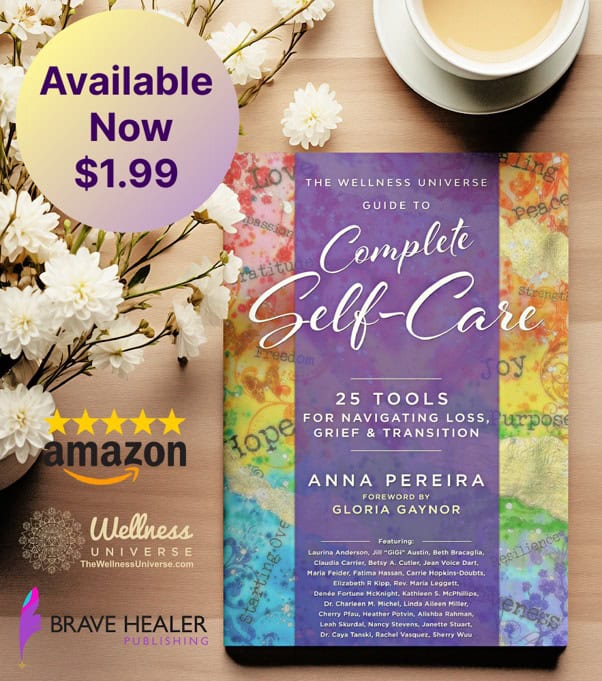
The Wellness Universe Guide to Complete Self-Care:
25 Tools for Navigating Loss, Grief and Transition
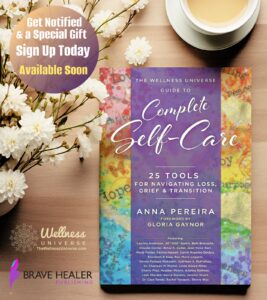
The Wellness Universe Guide to Complete Self-Care, #1 Bestselling book series brings more well-being support to you soon. 25 Tools for Navigating Loss, Grief & Transition available soon. Sign up now for free gifts and win a prize in our Mega Wellness Prize Bonanza – Over $20,000 in prizes & everyone will win:
👉 Join Our Launch Team & Win Prizes



The Wellness Universe is your resource for health, wellness, well-being, and transformation. We serve and support professionals who make the world a better place and individuals and groups who seek their best life.
A woman owned company; having the vision in 2013, Anna Pereira launched the first directory in 2015 bringing together a community of members making the world a better place to be found by those seeking their best life. The Wellness Universe has grown since then to be a one-stop shop for total wellness support! We are a vetted community, online directory, book publisher, resource center, event producer, content platform, and so much more, supporting whole-health and well-being on a global scale.
The Wellness Universe is a home that connects industry professionals in the health, wellness, and well-being fields to seekers of total well-being. WU provides our WU World-Changer members with peer support, Wellness Universe produced events (live and online), projects, visibility, business mentoring, and community. Through The Wellness Universe our WU World-Changer members serve WU Friends, seekers of health, wellness and transformation, with coaching, workshops, content and more.
The Wellness Universe provides individuals and groups seeking their best lives with access to our members, wellness content, educational resources, and guidance in all areas of wellness to transform visions of how they want to live life into the life they experience.
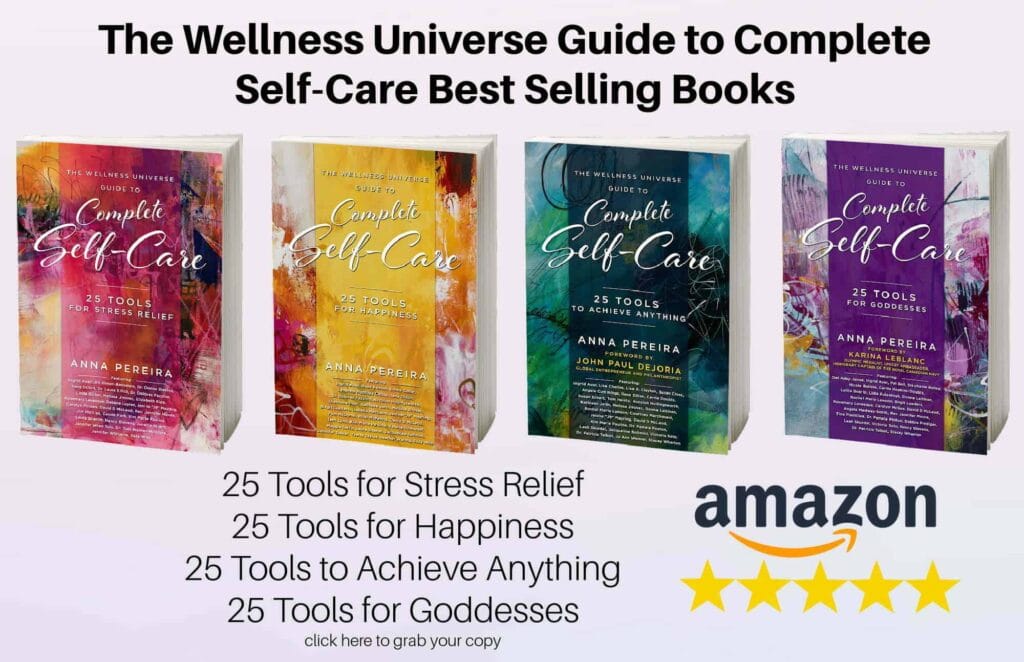
Through the directory, WU Featured Blog, SoulTreat wellness retreat, Self-Care Books, group well-being programs, and online learning center, The Lounge, The Wellness Universe provides many avenues to support whole health, mind, body, spirit and planet.
Join us today! Wellness Professional or Seeker of Your Best Life

Thank you, The Wellness Universe, for the reminder that grief extends far beyond the loss of a loved one. We can grieve friendships, dreams, identities, and even cherished possessions that hold pieces of our hearts. This article offers both validation and hope, reminding us that healing isn’t about “getting over” our losses but learning, with grace, how to carry them.