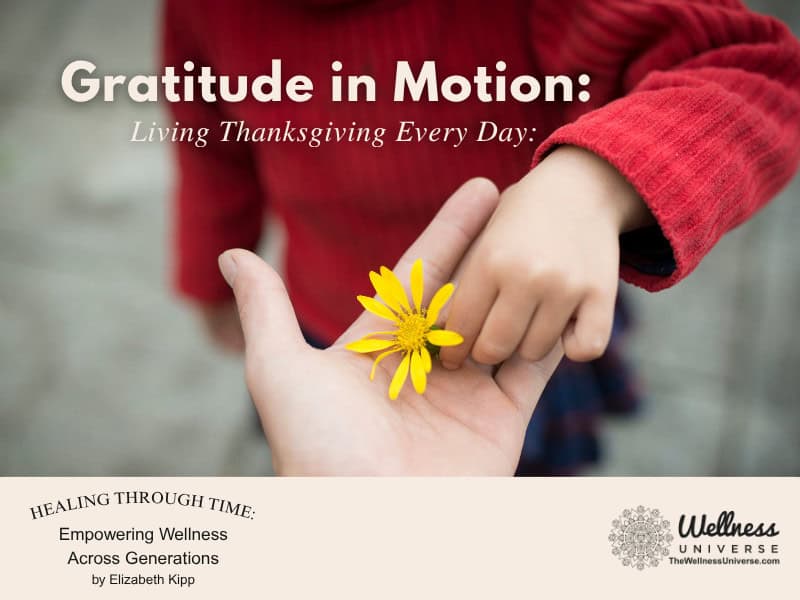
November naturally turns our attention toward gratitude. We gather around tables, share meals, reconnect with family and friends, and pause to acknowledge what we’re grateful for. For some of us, for a few days, gratitude moves closer to the center of our awareness. Then Thanksgiving passes. The dishes are put away, people travel home, the calendar fills again, and holiday preparations begin. Gratitude can quietly return to something we know is good for us but do not necessarily practice.
What if gratitude was never meant to be confined to a holiday? What if gratitude is more than a thought?
Gratitude offers us another opportunity to move from understanding healing to living it. When gratitude becomes embodied, it moves beyond saying, “I am grateful for this.” We pause long enough to feel gratitude in the body. We allow ourselves to receive the moment rather than rush past it. This is gratitude in motion.
Gratitude Isn’t Really About Positive Thinking
Gratitude is sometimes presented as a way to think positively. We may be encouraged to look on the bright side, count our blessings, or focus on what is good rather than what is difficult. Recognizing what is good has value, but gratitude loses its healing power when we use it to avoid pain.
If you are grieving, gratitude does not require you to pretend you are not sad. If you are frightened, you do not need to mask fear with a positive affirmation. If you are angry about something that happened, gratitude does not ask you to excuse it. We can experience gratitude and grief together. We can appreciate what is present while acknowledging what has been lost. We can be thankful for the life we have while staying honest about the parts of life that hurt.
This matters because the body knows when we try to override our experience. Healing does not ask us to deny what is present. It invites us to become curious about the whole experience. Gratitude becomes powerful when it expands our awareness rather than restricts it.
The Nervous System Notices What We Practice
The nervous system loves repetition. Throughout our lives, repeated experiences help create familiar patterns. When we repeatedly experience stress, uncertainty, criticism, pain, or fear, the nervous system learns to pay attention to cues associated with those experiences. This protective capacity helps us survive. The problem arises when vigilance becomes so practiced that we stop noticing anything else.
We can move through an ordinary day scanning for what might go wrong. The unanswered email captures our attention. The unexpected expense stays in our thoughts. The difficult conversation replays in our minds. The traffic irritates us, and the news alarms us. Meanwhile, the warm sunlight through the window, the friend who called, the food on the table, the tree outside, the dog sleeping nearby, or the simple fact that we took a full breath may barely register.
The nervous system is not doing something wrong. It has learned through repetition what deserves attention. And we can use that affinity for repetition to help us create another pattern.
An embodied gratitude practice deliberately brings awareness toward moments of support, connection, beauty, pleasure, kindness, and enoughness. We are not pretending danger or difficulty does not exist. We are allowing the nervous system to experience more of what is also true. This moment contains something nourishing, and we can stay here long enough to notice it.
From Knowing Gratitude to Feeling Gratitude
There is an important difference between knowing you are grateful and experiencing gratitude. You might know intellectually that you are grateful for your home, but what happens when you pause at your front door and feel what shelter means to you? You may know you appreciate a friend, but what happens when you allow yourself to receive the warmth of hearing that person’s voice? You appreciate the food in front of you, but what changes when you slow down enough to notice its color, aroma, texture, and taste, and recognize everything that happened before that food arrived on your plate?
Embodiment gives gratitude somewhere to land.
The next time something evokes gratitude, pause before moving on and notice your body. Notice if your chest softens or your face relaxes. You might experience warmth, spaciousness, a fuller breath, tears, or a quiet feeling that does not need a name. There is no right or wrong sensation here. The practice is simply to stay with the experience for a few moments instead of immediately moving to the next thing.
The body learns through experience. Let gratitude become one of those experiences.
When Gratitude Was a Survival Practice
Gratitude also has an ancestral dimension. Our ancestors lived through circumstances many of us can barely imagine. Some survived famine, war, migration, poverty, persecution, illness, loss, dangerous working conditions, or long periods of uncertainty. Their lives often depended upon cooperation, resourcefulness, and the ability to recognize what was available.
A harvest mattered; so did the weather. A safe place to sleep mattered, as did food preserved for winter. A neighbor who arrived to help mattered. The birth of a healthy child mattered. Gathering was not simply social; community helped people survive.
Human survival has always been relational. People shared food, resources, knowledge, labor, protection, celebration, and care. Gratitude may have arisen naturally within these experiences, not because life was easy, but because people understood how precious support could be.
And our lineages may also carry complicated relationships with gratitude.
When Gratitude Becomes Obligation
Some of us were taught gratitude through guilt. We may have heard messages like, “You should be grateful,” “Other people have it worse,” “After everything I’ve done for you,” or “Don’t complain. You have so much.” Messages like these can turn gratitude into obligation rather than genuine appreciation.
A child may learn that being grateful means ignoring disappointment. Someone receiving help may believe gratitude creates a debt that must be repaid. A person who has more than previous generations may feel guilty enjoying it. These patterns can become so familiar that we do not recognize how deeply they influence our capacity to receive.
This becomes especially important in ancestral clearing. People can carry a quiet belief that suffering connects them to their families. If our parents struggled, how can we have ease? If our grandparents lived through scarcity, is it safe for us to experience abundance? If previous generations sacrificed everything, are we allowed to rest? These questions may never be spoken aloud, yet they can shape how we receive life.
Healing invites another possibility. We can honor what our ancestors endured without repeating their suffering. We can be grateful for their resilience without making struggle our inheritance. One of the most meaningful ways we can honor those who came before us is to receive the life their survival helped make possible.
Gratitude as Receiving
This is where gratitude becomes deeply connected with receiving. To feel gratitude, we must first allow ourselves to recognize that something has been given. It might be a kindness, a meal, a conversation, a moment of beauty, an opportunity, rest, help, love, or simply another breath.
For people who learned to be hyper-independent, receiving can feel surprisingly vulnerable. We may be comfortable giving but uncomfortable accepting support. We might minimize compliments, refuse assistance, or immediately search for a way to repay kindness. Gratitude asks us to pause before doing that.
Can I receive this?
Can I allow someone to help me without immediately balancing the scales?
Can I enjoy this moment without wondering when it will end?
Can I recognize that something good is happening without bracing for what comes next?
These are nervous-system questions as much as philosophical ones. Receiving can become a practice.
Gratitude and the Reclamation of Joy
We can experience joy as part of healing rather than something we earn after healing is complete. Survival patterns can make joy unfamiliar because the nervous system has learned to prioritize vigilance, responsibility, and protection. Gratitude can become a doorway back to joy, not forced joy or constant happiness, but the quieter joy that appears when we are present enough to notice life.
Perhaps you hear someone you love laughing in another room. Maybe you step outside and notice the smell of rain. You taste the first sip of morning coffee or tea. A stranger holds the door. Someone remembers your birthday. Your body carries you through another day.
These moments may seem ordinary, and that is precisely why they matter. A life is largely made of ordinary moments. If we wait for extraordinary circumstances before allowing ourselves to experience gratitude, we may miss much of our lives.
A Practice of Gratitude in Motion
For the next week, experiment with allowing gratitude to become a bodily practice. Once each day, notice something you genuinely appreciate. Do not search for something impressive. Let it be real.
Pause and notice what you see, hear, smell, taste, or feel. Then notice your body and ask quietly, “What happens in me when I allow myself to receive this?” Stay with whatever you notice for a few breaths. If nothing changes, that is fine. There is no experience you need to create.
If it feels natural, say quietly, “Thank you.” You do not have to decide who or what you are thanking. You may be thanking another person, your body, the Earth, your ancestors, God, the Divine, Life itself, or simply acknowledging the moment. Then continue with your day.
The practice may take less than a minute. What matters is repetition.
Extending Gratitude Into Relationship
Gratitude becomes even more powerful when it moves outward. Think of someone whose presence has mattered in your life. Perhaps they supported you through a difficult time, taught you something important, made you laugh when you desperately needed laughter, or treated you with kindness when you expected judgment.
Tell them.
We often save our deepest appreciation for eulogies, memorials, retirement speeches, and farewell letters. What if we became more generous with gratitude while people were here to receive it? A simple message can be enough: “I was thinking about you today, and I realized how grateful I am that you are in my life.”
Notice what happens when you express that appreciation. And notice what happens when someone offers gratitude to you. Can you receive it without deflecting? Can you allow their words to land? This, too, is gratitude in motion.
Becoming a Grateful Ancestor
Ancestral clearing looks backward, but it also looks forward. We are someone’s ancestors in the making. What do we want to pass forward?
Perhaps one of the gifts we can offer future generations is a different relationship with enoughness, receiving, joy, and appreciation. We can create families where gratitude does not mean denying pain. We can teach children to appreciate what they have without shaming them for wanting or needing something. We can create communities where people express appreciation freely and receive it without embarrassment. And we can become people who notice goodness without pretending hardship does not exist.
Every time we pause to receive something nourishing, we interrupt the habit of rushing past life. Each time we express sincere appreciation, we strengthen connection. And when we allow joy without guilt, we loosen an old survival pattern that may have traveled through generations.
Gratitude becomes part of the legacy we leave.
Living Thanksgiving Every Day
Thanksgiving can remind us to gather around a table and recognize what matters, but gratitude does not need to end when the meal does. We can carry Thanksgiving into an ordinary Tuesday morning. We can practice it in the grocery store, on a walk, while washing dishes, during a conversation, or in the quiet moment before sleep.
We can notice what supports us, receive what nourishes us, and express appreciation while people are here to hear it. And when life is difficult, we do not need to manufacture gratitude. We can remain honest about what hurts while leaving room to notice what is still holding us.
This is gratitude as embodiment. It is not a demand to feel thankful. It is an invitation to become present enough to recognize what is already here.
Since the nervous system loves repetition, we can give it something new to practice: moments of receiving, appreciation, connection, enoughness, and joy. One moment will not erase generations of survival patterns, but one moment can become another, and another. Over time, gratitude moves from an idea we remember each November into a way we inhabit our lives.
This is what it means to live Thanksgiving every day. We do not pretend everything is good. We become available to the goodness that is here. We do not deny what has been lost. We receive what remains. And we do not honor those who came before us by carrying their suffering. We honor them through the fullness with which we live our own lives.
Gratitude becomes movement, relationship, and a living legacy.
Connect with Elizabeth on The Wellness Universe and follow her on Facebook and Instagram.
#1 Bestseller Available Now
The Wellness Universe Guide to Complete Self-Care:
25 Tools for Navigating Loss, Grief and Transition
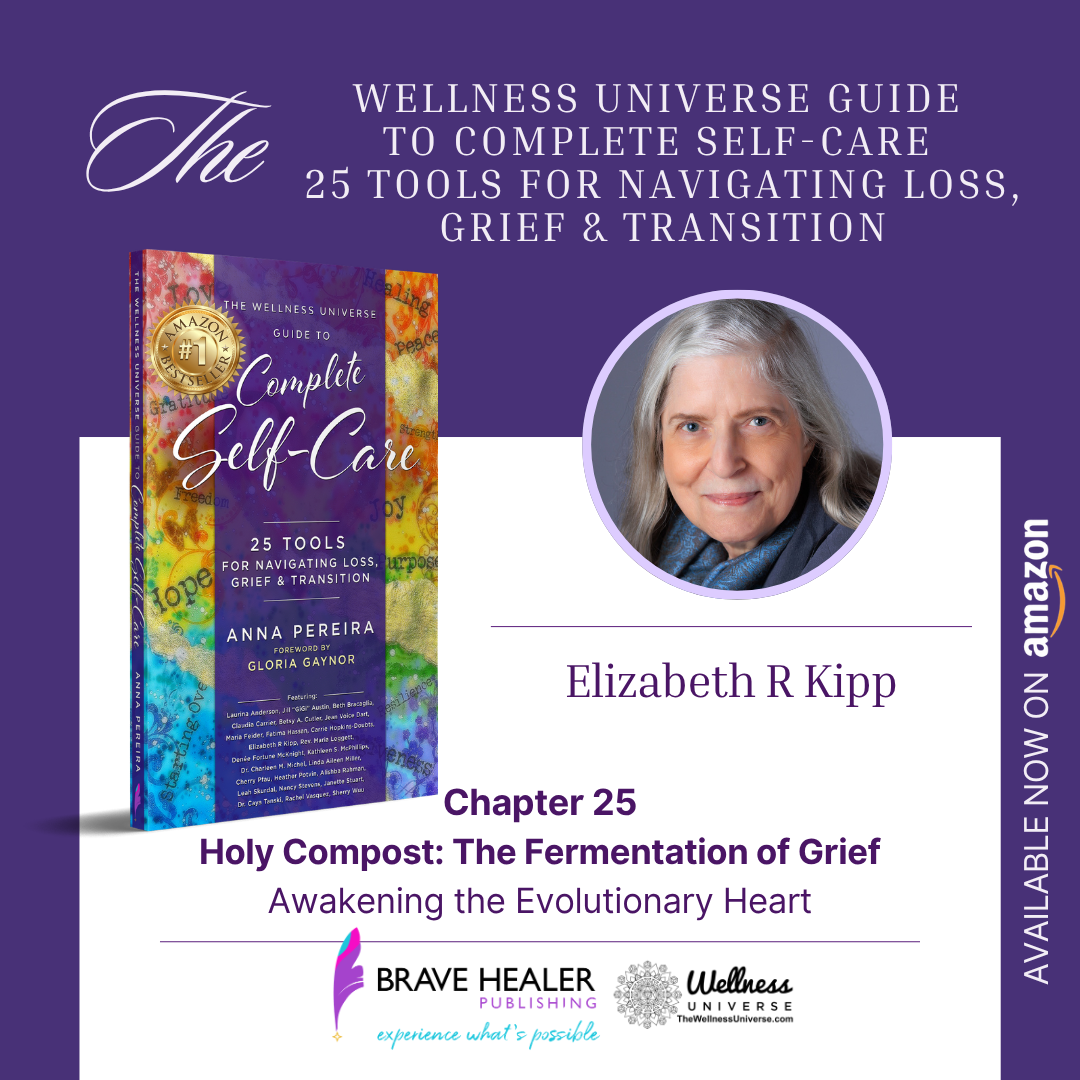
The Wellness Universe Guide to Complete Self-Care, a #1 Bestselling book series, brings more well-being support to you. 25 Tools for Navigating Loss, Grief & Transition is available now.
 Grab Your Copy Today for $1.99!
 Grab Your Copy Today for $1.99!

Healing. Here. Now. Mindfulness, Trauma, and Recovery is a course for self-care and healing brought to you in partnership with Elizabeth Kipp, Founder of Elizabeth Kipp Stress Management, LLC and Wellness Universe Trauma Expert Leader exclusively for Wellness for All programming.
Catch the replay – https://bit.ly/HealingHereNow
A Transformational Journey Workshops
Unlock the full transformational journey with all 29 powerful workshops!

Blessing for Your Transformation
with Elizabeth Kipp
Step into a powerful journey of healing and renewal with a live reading of Blessing for Your Evolutionary Transformation from the #1 best-selling book series The Wellness Universe Guide to Complete Self-Care: 25 Tools for Transformation. Release what no longer serves you, reconnect with your inner strength, and rediscover your purpose with clarity and peace. Join live for an inspiring experience of growth, conversation, and transformation—you don’t want to miss it!



Elizabeth is a Health Facilitator, Empowerment Coach, EFT/Tapping and Ancestral Clearing Practitioner, and Kundalini Yoga Teacher, helping people to step into the power of their own healing. She has turned her attention as a patient advocate and health facilitator in service to the alarmingly high population of people who suffer from stress, chronic pain, and the quest for a life free from suffering.