
The year is 1947. The South Asian subcontinent is divided into Pakistan and India, and the fate of my ancestors is being decided by the drawing of a haphazard line across a heavily populated and diverse province.
Pandemonium rules the streets. People on either side are thrown into mayhem, driven by fear and frustration; all human faculties descend into the most primal instincts of survival. Learned and evolved human behaviours are stripped away: monsters are made of those who stay, prey of those who have to run.
Children are being murdered by their own mothers to save them from a fate far worse. Sikh fanatics swing little babies into the air and let them fall onto the tips of their swords. Killing a Muslim has become a medal overnight. The other side was hardly any better. Colonialism has succeeded in dividing two peoples who speak the same language and have lived together for centuries. The divide in their hearts and souls becomes a chasm far deeper than the Radcliffe Line between India and Pakistan.
My great-grandfather runs, burying his family’s gold in the ground to save it from plunder on the roads, not knowing he is giving his last precious belongings back to the elements. He escapes; his brothers and their sons stay, unable to part with their house, overestimating the strength of their arms.
He walks a mile and, overcome by the grief of leaving, runs back to see if his brothers will change their minds.
Entering the gate, he falls to his knees. All his kin are taking their last breaths, their throats slit by swords. Blood pools as the milk still boils over coal, waiting for a day of tea and family—milk that does not know the sun rose today only to be eclipsed by the crimson pools of family lines.
He runs from one to another, then takes a few ounces of milk and pours them into the mouth of the one who still seems to be breathing. A last taste, given by the hands of a brother.
Without thinking again, he escapes, never to return.
He doesn’t know it yet, but his mother, a few miles ahead—sent earlier with a teenager to keep her safe—is soon to begin a train journey across the nascent border. She will end up lost forever, unable to get off at the right station, unable to keep pace with the young boy accompanying her.
She will never be found again.
He doesn’t know it yet, but he will lose many more on the way to the land allotted to them in the middle of a desert. Many will succumb to hunger, some to rape and ravaging, and others to disease.
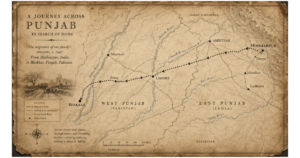
Hoshiarpur to Bhakkar: An Ancestral Journey
From Hoshiarpur in East Punjab to Bhakkar in West Punjab, this map traces the migration that became part of my family’s history after Partition. Across borders, rivers, plains, and unfamiliar land, the journey was not simply from one place to another. It was a journey toward a new home. Illustrative reconstruction of the family migration route, c. 1947.
***
Those members of the family who survive settle in the desert that was allotted to them, in place of the fertile, tilled farmland and well-built houses they left behind. The heat is scorching. They are now 445 kilometres away from home.
But this is home now.
So they build.
They build houses of mud, half underground; it is cooler that way. They plough and till with their hands. Each seed is sown and each harvest borne out of traumatised hands.
Their minds are broken. Anxiety and trauma have swallowed them; they absorb it into their blood, cursed to have it run through the veins of generations to come.
Ever more resilient, ever more adaptable, ever more humble—and forever traumatised and anxious.
Grief on this scale sticks to your skin. It passes down through generations.
And every mode of catharsis—through art, expression, or even words—has been lost along the way. You must build from scratch. You must overcome every fear and anxiety, defeating the looming shadow of scarcity ingrained in your worldview.
***
In such dire circumstances, my grandparents envisioned a life for my father and his siblings far beyond anything they themselves could imagine. They dreamed of their children reaching the highest ranks of power and service in their new homeland, of building stable lives, and they had only one means to achieve it: education.
It feels almost impossible that they succeeded.
Their expansive vision, born in the dust of the Thal Desert, manifested a life of possibilities beyond their faintest imagination as their sons joined the higher cadres of the military, bureaucracy, and police.
I come from the next generation—the first to hold a pen and offer catharsis to this entire journey.
***
There is yet another face to a life built from scratch.
Trauma rules the day. Every interaction is governed by fear, and a scarcity mindset keeps you from ever enjoying the bounties you build. They never feel like your own; you never believe yourself worthy of them.
Your eyes twitch from the sustained stress of the mundane, carried to you on the bare back of trauma—the one shadow that walks beside you, so afraid of its own existence.
Seeking love, affection, warmth . . . yet unable to give any.
You are stiff. You are blunt. You are stringent.
And yet, you are so deeply desirous of warmth and kindness, of safety and security. Of someone telling you: it is all okay. You are safe now.
The loss you feel—you have outgrown it.
You are now more expansive in your being. You have become a star so magnificent that the trauma and loss of the past have been reduced to a distant planet orbiting you. It will never cross your path again as it once did. Your entire trajectory is your own now.
You must look ahead toward your destiny.
For my father, this was never easy. Hypertension, chronic anxiety, and a boatload of generational trauma have added so much friction to his life. Their reach has been so enormous that they have halted and obstructed my life and growth, as well as those of my siblings. So contagious that I inherited the disorders that have disturbed him his entire life.
He would have given the world to us had he not been so restrained by this invisible ball and chain. Yet he could have done far more to be kinder and warmer when we were little. He could have been softer, lighter to be around.
I’d like to think it never occurred to him what any of this meant. He was doing his best, and when your peace has been ravaged by generational trauma, your best can sometimes still be insufficient.
***
I write this blog to share the context behind my chapter in the book The Wellness Universe Guide to Complete Self-Care: 25 Tools for Navigating Loss, Grief and Transition.
I write to share the nuanced nature of loss and grief, and to say that expressing your part of it is never too much. It is never unjustified. You have the right to share your pain and your experience, and to heal, while still acknowledging the circumstances of others.
For years, I reduced my own pain to explanations and justifications for the trauma each generation before me had faced. But that was unfair to me. And in many ways, this blog too is a justification for my chapter. The chapter about my loss and grief, the grief that, when measured on the scales next to my ancestors, feels insignificant. However, it is mine to share and mine to heal from.
I understand now that, to heal and look ahead, I must see my own wounds as worthy of attention and healing. My anxiety disorders, born from years of trying to prove my worth, and the generational trauma that has reached me deserve to be healed so that I do not pass them down to the next generation.
So I declare, it must end here.
Below, I have created some images to depict the scenes of migration and resettlement of my ancestors.
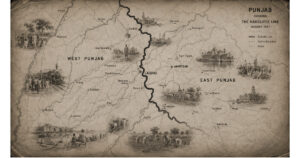
The Radcliffe Line, 1947
The line that divided Punjab in 1947 redrew more than territory. It cut through towns, farmland, roads, and communities, transforming familiar landscapes into two new nations. Historical reconstruction.
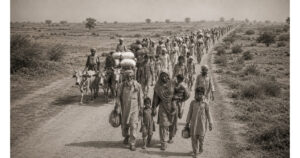
Migration from India to Pakistan, 1947
In the upheaval of Partition, millions crossed the newly created border carrying what they could and leaving entire lives behind. Muslim families from East Punjab were among those who travelled westward in search of safety and a new home in Pakistan. Historical reconstruction.
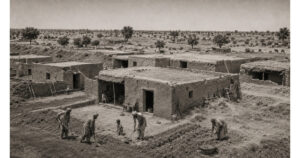
Thal Desert, Bhakkar, 1950s
For families rebuilding their lives after Partition, arrival was only the beginning. In the harsh landscape of the Thal Desert near Bhakkar, new homes were shaped from earth, labour, necessity, and the determination to begin again. Historical reconstruction.
What is Generational Trauma?
Generational trauma, sometimes called intergenerational trauma, describes the ways the effects of overwhelming experiences can continue to shape families long after the original event. Fear, parenting patterns, beliefs about scarcity and safety, family silence, and learned ways of responding to stress can all carry elements of an earlier generation’s survival into the lives of their descendants.
Connect with Fatima Hassan on The Wellness Universe. Reach out to her on her LinkedIn and on Instagram.
COMING SOON!
The Wellness Universe Guide to Complete Self-Care:
25 Tools for Navigating Loss, Grief and Transition
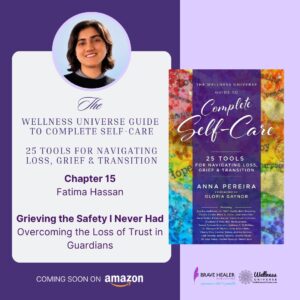
The Wellness Universe Guide to Complete Self-Care, #1 Bestselling book series brings more well-being support to you soon. 25 Tools for Navigating Loss, Grief & Transition available soon. Sign up now for free gifts and win a prize in our Mega Wellness Prize Bonanza – Over $20,000 in prizes & everyone will win:
👉 Join Our Launch Team & Win Prizes





Oh Fatima, thank you for sharing your family’s history of unimaginable personal tragedy, loss, resilience, and the generational impact that followed. I loved your reminder that we never need to compare or diminish our own grief because someone else has suffered differently. Our pain is ours to acknowledge, honor, and heal. Your declaration, “It must end here,” holds so much courage, hope, and love for the generations that follow.
Thank you, Fatima, for sharing your family’s story of resilience in the face of horrific conditions. I didn’t know the history of the Partition between Pakistan and India. I am grateful for your courage to tell your story of healing and personal growth through intergenerational trauma. As we process our family’s grief, we open doors for other people’s healing.