

You got the result you wanted.
Someone said your name in a room like it meant something. And before you’d fully landed in it, before it was even finished, you heard yourself say: “Oh, it’s nothing. That’s just what I do.”
They meant it as a compliment. You turned it into a footnote. You’ve been doing that for a long time.
The Dimming
I call this the Dimming Strategy.
This isn’t the pattern that keeps people from starting. It’s the one that runs after they’ve already won—the mechanism that makes high-achievers shrink the very thing they just built.
It’s the automatic redirect when someone compliments your work. The self-deprecating footnote you add to every success story.
The raise you negotiated—then softened with three months of extra deliverables so the price felt “fair.”
The LinkedIn bio that undersells you because the accurate version felt like too much.
You learned somewhere along the way that full-volume ambition makes people uncomfortable. So you turned the dial down. Kept the wanting—just made it inaudible.
This started so long ago you’ve stopped noticing. But the signal is always the same: something good happens, and you immediately make it quieter.
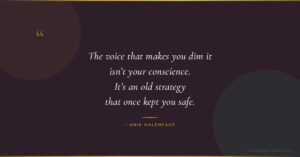
How It Sounds When It Runs
Tell me if you recognize any of these:
“I don’t want to seem like I’m bragging.”
“I can’t put that on my bio—people will think I’m exaggerating.” “Oh, it was nothing, no problem.”
That last one. Said while knowing full well it was a lot. That’s the tell.
The Dimming Strategy at its most sophisticated doesn’t make you stop. It just makes you defer. You achieve—then immediately hand the credit somewhere else. The timing. The team. Anything but you.
Lucky. Like what you built had nothing to do with you.
The Day I Acted Dumb to Climb the Ladder
I spent fifteen years in an industry where ambitious women learned to make themselves invisible to survive.
The unspoken rule was simple: don’t threaten egos in the room. The women who made it were sharp, guarded, stripped of anything that read as too much. Too emotional. Too ambitious. Too visible. Competence wasn’t currency.
So I adapted. One small adjustment at a time, until the adjustments became a performance.
I started asking questions I already knew the answers to. Letting people explain things to me that I understood better than they did. Softening my delivery. Crediting other people’s contributions in ways that subtly minimized my own. Positioning things so that others would think it was their idea—and I happily let them have it, so I wouldn’t have to fight for the changes I saw were needed. I wanted things—but I did it quietly. To move toward what I was building without letting anyone see I was reaching for it.
And it worked. I became one of the youngest branch managers of a multi-million dollar firm by thirty. The strategy delivered everything it promised.
What it cost me took longer to see. Every performance of smallness had been a brick. Not in a wall I was building toward something—in a ceiling I’d constructed over my own head. By the time I understood what I’d been doing, I’d been doing it for so long it had become more than a habit—it was an identity. I treated my desires like something to be managed. Ambition at full volume was something other people did. People who didn’t understand the room the way I did.
Leaving that industry wasn’t just a career change. It was an excavation. Finding out who I was when I wasn’t busy managing everyone else’s ego.
Leanne Was Running the Whole Restaurant
Recently, in a group session, Leanne told us about her first marriage.
She and her husband had run a restaurant together. She did everything—the operations, the staff, the customer experience, the invisible infrastructure that made the whole thing work. He was the face. She was the engine nobody saw.
When customers would walk in and look at her—her, the person who had built the daily reality of that place—and ask: “Do you work here?”
She’d say: “Yeah. I work here.”
Not “I run this place.” Not “I’m the co-owner.” Yeah. I work here. I watched the room get very quiet when she said it.
Then she told us why she was in the session: she was about to launch a new business. With her new husband.
I said it out loud: “We want to make sure that the old way of getting success—the one where you ran everything and he was the face—isn’t the pattern you bring into this new chapter.”
She already knew. That’s why she was there.
The Dimming Strategy doesn’t just run in your business. It runs in every arena where you’ve learned that making yourself the visible one—the one who gets credit, the one whose name goes on the thing—feels dangerous. Or arrogant. Or like too much to claim.
Same pattern. Different room. For Leanne, it was a marriage and a restaurant. For you, it might be a boardroom, a salary conversation, or a budget decision about your family’s finances. But the architecture is identical: you do the work and find a way to leave yourself in the background.
The Subconscious Tax
Here’s what makes it so durable: the subconscious enforces it.
A client I’ll call Rochelle—brilliant, self-aware, already doing significant inner work—caught herself in a specific belief she’d never examined: I only get one good day.
Not one good day ever—just one good day at a time. One win before the debt comes due.
It wasn’t pessimism. It was an internal quota system. The subconscious saying: you’ve had enough for now. Dim it down before something comes to take it back.
That’s the Dimming Strategy at its most interior—not about what other people will think, but about the internal tax you levy on your own expansion. The belief that ambition has a debt attached. That wanting at full volume will be corrected. That the good days need to be rationed.
When things are actually going well—when you’re genuinely rising—this is the moment the old pattern surfaces most loudly. Not to destroy you. To protect you from the unfamiliarity of your own expansion.
Your subconscious doesn’t distinguish between dangerous and unfamiliar. It just flags the expansion and contracts. Turn it down. Get back to baseline.
That’s not wisdom; it’s a pattern that’s past its expiry date.
What Ambition Actually Looks Like When You Stop Dimming It
There’s a woman I’ll call Yvonne. After a visualization exercise in a group session, she described her inner child — the part of her that remembered what it felt like before the dimming was installed.
Her inner child had a fork in her hand. Ready to eat. Taking a bite of life.
That image stayed with me. Not about wanting everything. Just about being willing to receive what was already on the plate. To pick up the fork. To actually eat.
Your ambition isn’t greedy. It’s appropriate. It’s the right size for what you’ve actually built.
Every performance of smallness has been a brick—not in a wall you were building toward something, but in a ceiling you constructed over your own head.

Your Audit—This Week
One question. Chest answer, not head answer.
“Where am I currently dimming something that deserves to be at full volume?”
Be specific. The win you told three people about instead of thirty—why that number? The answer that makes your stomach tighten slightly is the right one.
You don’t have to blow anything up today. You just have to name it. And stop pretending the dial isn’t in your hand.
Your Next Move
You’ve been turning down the dial for so long that it feels like your natural volume. It isn’t.
At some point, the work requires you to stop making yourself smaller than what you’ve built.
That’s not arrogance; that’s just owning your value.
This is where inner work becomes the strategy forward. Let’s find the specific pattern underneath your specific ceiling. It’s time to stop outsourcing your own authority. ChatWithAnik.com
— Anik
Connect with Anik on The Wellness Universe and follow her on Facebook and YouTube.
COMING SOON!
The Wellness Universe Guide to Complete Self-Care:
25 Tools for Navigating Loss, Grief and Transition

The Wellness Universe Guide to Complete Self-Care, #1 Bestselling book series brings more well-being support to you soon. 25 Tools for Navigating Loss, Grief & Transition available soon. Sign up now for free gifts and win a prize in our Mega Wellness Prize Bonanza – Over $20,000 in prizes & everyone will win:
👉 Join Our Launch Team & Win Prizes
Take My Hand Support Series

Wellness in the Workplace
Research shows that workplace wellness is a serious global concern, with rising levels of burnout, emotional exhaustion, and mental health decline across industries. Many employees struggle under chronic stress, long hours, and high‑pressure environments that leave them vulnerable to depression, anxiety, and suicidal ideation. This session addresses these challenges head‑on, offering insight, education, and compassionate support for individuals and organizations seeking healthier ways to work and live.
Join us for “Wellness in the Workplace,” on Saturday, July 11, 2026, hosted by Jean Voice Dart, Psychotherapist, Grief, Trauma, and Chronic Pain Specialist, with guest speakers:
- Sonya Bohmann — Executive Director, Construction Industry Alliance for Suicide Prevention
- Meagan Hopper — Certified Wellness Specialist & High‑Pressure Leadership Consultant
- Linda Dieffenbach —Trauma‑Informed Coach, Workplace Wellness & Suicide Prevention Advocate
Together, they explore workplace stress, mental health, and suicide risk, examining how high‑demand environments contribute to burnout, emotional overload, and feelings of isolation. Our panelists will share evidence‑based strategies, effective resources, trauma‑informed practices, and real‑life examples that provide proven pathways to healing.
You are not alone, and your mental wellness matters.
⏰12:00pm ET/9:00am PT
Register & Join Live: https://bit.ly/WUTakeMyHandSupportSeries






Such a powerful message, Anik. I think many of us have learned to quietly minimize our gifts without even realizing it. Thank you for the gentle reminder that owning our value is not arrogance. It is a beautiful act of self-respect and allows us to shine our light more fully in the world.