

We’ve all seen the word “burnout” tossed around like it’s just a phase you can sleep off or solve with a spa day.
But burnout is not just being tired.
It’s not just needing a vacation.
It’s a full-body, full-mind crash that doesn’t go away with a good night’s sleep.
Burnout is real. And for many, it creeps in so slowly that by the time you recognize it, you’re already deep in it. This isn’t just a trendy workplace phrase—it’s a very real mental, emotional, and physical condition.
Let’s break the myth and get honest about what burnout actually looks like in real life (IRL).
Burnout Isn’t Drama, It’s Dangerous
The World Health Organization classifies burnout as an “occupational phenomenon” caused by chronic workplace stress that hasn’t been successfully managed. It’s marked by:
- Exhaustion
- Mental distance or negativity toward one’s job
- Reduced performance
But you don’t have to work in a toxic office or be a corporate overachiever to feel it. Burnout can hit anyone, not just the nine-to-fivers. Anyone juggling too much, for too long, without support is at risk.
So, What Does Burnout Look Like IRL?
Research shows that the symptoms of burnout go beyond just feeling tired. They include a mix of emotional, physical, and behavioral signs that build up over time. Here’s a summary in simple terms:
Common Symptoms of Burnout
Emotional Exhaustion
– Feeling constantly drained, even after sleep
– Numbness or lack of motivation
– Mood swings, irritability, or emotional flatness
Cognitive and Mental Fog
– Trouble focusing or remembering things
– Decision fatigue—everything feels overwhelming
– Creativity and problem-solving feel harder than usual
Detachment and Loss of Joy
– Losing interest in things you used to care about—even your own goals or business
– Feeling disconnected from others, or like no one “gets” you
– Cynicism or resentment toward work or people
Physical Signs
– Chronic fatigue or insomnia
– Headaches, muscle tension, or stomach issues
– Weakened immune system—getting sick more often
Behavioral Red Flags
– Overworking to avoid feelings (e.g., staying busy 24/7)
– Withdrawing from social life
– Using substances, food, or screens to cope
These symptoms often sneak up gradually, which is why many people don’t realize they’re burned out until they hit a breaking point. Recognizing the signs early is key to recovery.
Effects on the Brain
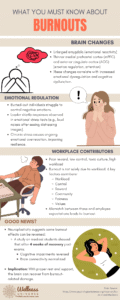
Burnout isn’t just feeling tired after a long week—it’s a full-body and brain-level crisis that can drastically affect your mental, emotional, and physical health. Scientifically, burnout manifests through measurable changes in the brain: the amygdala (which processes emotions) becomes overactive, while areas responsible for regulation and decision-making, like the medial prefrontal cortex (mPFC) and anterior cingulate cortex (ACC), shrink or weaken in connectivity. These changes mean people experiencing burnout have more difficulty managing their emotions, staying focused, or thinking clearly. Over time, chronic stress wears down the body’s stress-response system (the HPA axis), eventually leading to abnormally low cortisol levels—a state linked with fatigue, immune dysfunction, and even increased risk of heart disease.
It Feels like a Concussion
Contrary to popular belief, burnout isn’t just about working long hours. It stems from a deeper mismatch between a person and their workplace in six key areas: workload, control, reward, community, fairness, and values. Jobs that demand emotional investment—like those in healthcare, education, social work, or leadership—are especially high-risk. Studies show that burnout can affect cognitive function just like a concussion does, impairing memory, decision-making, and creativity. These effects can become so severe that people in burnout start feeling emotionally numb, lose passion for their work, and become cynical or detached.
Why Burnout Is So Sneaky
The problem with burnout is that it’s slow and silent.
It starts as “a busy week.”
Then a “crazy month.”
Then you blink and it’s been a year of running on fumes.
It doesn’t announce itself with sirens—it whispers:
“Just push a little more.”
“Once this project ends, I’ll rest.”
“Everyone else is tired too.”
“This is just how success feels.”
But no. That’s not success. That’s survival mode.
The Cycle That Keeps You Stuck
Research has shown that there is a vicious cycle of burnout where chronic stress overwhelms the brain and body, leading to emotional exhaustion, poor decision-making, and reduced cognitive function. This, in turn, makes it harder to cope with stress, which worsens the burnout, creating a self-reinforcing loop. Specifically:
- The brain’s emotion-processing center (amygdala) becomes more reactive.
- Areas like the mPFC and ACC, which help regulate emotions and make decisions, become weaker or less connected.
- The stress system (HPA axis) becomes overloaded and eventually underperforms, causing low cortisol, fatigue, and physical symptoms.
This dysfunction in the brain and body makes it harder to recover or make good choices, so people keep pushing themselves harder, often without realizing they’re in burnout, thus continuing the cycle.
Good News? Burnout Is Fixable
If you’re feeling completely drained, emotionally numb, or like you’re running on empty no matter how much you rest, you’re not broken. You’re probably burned out. And the good news? You can recover.
Your brain and body are built to heal. Scientists have found that even after major stress (like intense exams), people’s brains can bounce back within a few weeks of proper rest. That means burnout doesn’t have to be permanent, but it does need your attention.
Step 1: Give Yourself Real Rest
This doesn’t mean just one day off. It means giving your mind and body time to truly unwind. That could be better sleep, quiet time without screens, getting out in nature, or even just doing something fun that isn’t about being productive.
Step 2: Cut Down the Stress
Burnout won’t go away if you keep going back to the same overloaded schedule or toxic work environment. Ask yourself: What’s draining me the most? What can I say no to? Sometimes, small changes (like setting work limits or asking for help) can make a big difference.
Step 3: Talk to Someone
You don’t have to handle burnout alone. Talking to a therapist, coach, or even a trusted friend can help you make sense of what you’re going through. Just being heard can help ease the emotional weight you’re carrying.
Step 4: Redefine What Success Looks Like
Many of us burn out chasing goals that don’t even make us happy. Healing often means asking: What kind of life do I actually want? Real success includes peace of mind, joy, connection, not just ticking off boxes.
Final Thought
Burnout isn’t a badge of honor.
It’s not the price of ambition.
And it’s not inevitable.
Remember, you don’t have to earn your rest, you don’t need permission to pause, and you don’t have to wait until you collapse to start healing.
Burnout is real—and so is your right to recover.
Quick Reflection:
“If my energy were a bank account, would I be in overdraft?”
If the answer is yes, start making deposits today. You deserve more than survival mode. You deserve to feel alive in your life.
Sources
- Association for Psychological Science. (2016, March 1). Burnout and the brain. APS Observer. https://www.psychologicalscience.org/observer/burnout-and-the-brain
- Blix, E., Perski, A., Berglund, H., & Savic, I. (2013). Long-term occupational stress is associated with regional reductions in brain tissue volumes. PLOS ONE, 8(6), e64065. https://doi.org/10.1371/journal.pone.0064065
- Oosterholt, B. G., Maes, J. H., Van der Linden, D., Verbraak, M. J., & Kompier, M. A. (2015). Burnout and cortisol: Evidence for a lower cortisol awakening response in both clinical and nonclinical burnout. Journal of Psychosomatic Research, 78(5), 445–451. https://doi.org/10.1016/j.jpsychores.2014.11.003
- Savic, I. (2015). Structural changes of the brain in relation to occupational stress. Cerebral Cortex, 25(6), 1554–1564. https://doi.org/10.1093/cercor/bht348
- Schaufeli, W. B., Leiter, M. P., & Maslach, C. (2009). Burnout: 35 years of research and practice. Career Development International, 14(3), 204–220. https://doi.org/10.1108/13620430910966406
#1 BEST SELLER AVAILABLE NOW!
The Wellness Universe Guide to Complete Self-Care, 25 Tools for Transformation

The Wellness Universe Guide to Complete Self-Care: 25 Tools for Transformation officially launched July 8, 2025! Inside, 35+ heart-led experts share real stories and powerful self-care tools to support your healing, resilience, and personal growth. Whether you’re navigating change or ready to rise to your next level, this book offers practical guidance and soul-deep inspiration to help you thrive.
For a limited time, get your copy at this special launch price. Purchase your eBook now or paperback!
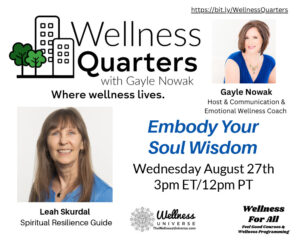
Wellness Quarters with Gayle Nowak
Guest: Leah Skurdal
Topic: Leah Skurdal: Embody Your Soul Wisdom
Leah Skurdal shares a simple way to toggle from ego to soul and embody your soul wisdom to make stronger, more satisfying decisions.
Register & Join Live: https://bit.ly/WellnessQuarters


The Wellness Universe is your resource for health, wellness, well-being, and transformation. We serve and support professionals who make the world a better place and individuals and groups who seek their best life.
A woman owned company; having the vision in 2013, Anna Pereira launched the first directory in 2015 bringing together a community of members making the world a better place to be found by those seeking their best life. The Wellness Universe has grown since then to be a one-stop shop for total wellness support! We are a vetted community, online directory, book publisher, resource center, event producer, content platform, and so much more, supporting whole-health and well-being on a global scale.
The Wellness Universe is a home that connects industry professionals in the health, wellness, and well-being fields to seekers of total well-being. WU provides our WU World-Changer members with peer support, Wellness Universe produced events (live and online), projects, visibility, business mentoring, and community. Through The Wellness Universe our WU World-Changer members serve WU Friends, seekers of health, wellness and transformation, with coaching, workshops, content and more.
The Wellness Universe provides individuals and groups seeking their best lives with access to our members, wellness content, educational resources, and guidance in all areas of wellness to transform visions of how they want to live life into the life they experience.
Through the directory, WU Featured Blog, SoulTreat wellness retreat, Self-Care Books, group well-being programs, and online learning center, The Lounge, The Wellness Universe provides many avenues to support whole health, mind, body, spirit and planet.
Join us today! Wellness Professional or Seeker of Your Best Life


Thank you, The Wellness Universe, that burnout isn’t just “being tired”—it’s a total mind-body crash that can sneak up on you before you even realize it. I love how this article shines a light on the real symptoms and reminds us that rest isn’t a luxury, it’s a necessity.