

High achievers often learn early how to hide their stress behind a practiced smile. Whether they are athletes under stadium lights, caregivers working through the night, firefighters running into danger, or musicians performing through trembling hands, they carry a lifetime of pressure that rarely shows on their faces. The smile becomes a shield—a way to stay strong, stay composed, stay dependable—even when the strain beneath it grows heavy.
Reclaiming Joy
At five years old, I sat backstage at a piano recital with my feet barely touching the floor. My hands trembled above the keys as my teacher whispered, “You’re ready.” I nodded, even though my stomach was in knots. I loved music, writing, art, dance, and dramatic arts, but I also carried a quiet, constant anxiety I didn’t yet have words for. Like so many high achievers, I learned early how to persevere through stress and pain, seeking triumph over trauma. Yet, I wasn’t truly happy. I didn’t realize that joy was what I needed. Joy would relieve the angst of suffering in silence. After many years of practicing a disciplined life, I’ve found and reclaimed joy. It is forever mine now.
Consider Margie, a seventeen‑year‑old athlete who sits lacing her shoes in the dark before sunrise. Workout. School. Practice. Homework. Sleep. Repeat.
Her coach pats her on the shoulder, “Champions never take breaks.” Margie listens and pushes herself beyond heartache and pain, yet she wonders, If I stop being a soccer player, who am I?
Ronaldo, a caregiver, finishes a ten‑hour shift caring for his aging mother, then heads straight to his second job. His sister asks, “When do you rest?”
Ronaldo laughs softly while giving her a hug. “Maybe next month.” He loves his mother deeply, but the constant giving leaves him running on fumes.
My story and the stories of Margie and Ronaldo reflect a truth high achievers and overachievers rarely discuss: They often spend a lifetime hiding stress, as the silent strain takes a toll on their physical, emotional, and social well‑being.
Mental health challenges and suicidal ideation are not uncommon among high achievers. However, the journey doesn’t need to end there. With awareness, spiritual grounding, and daily practices, high achievers can learn to release stress and reclaim joy.
Behind the Curtain of High Performance
When “Doing Your Best” Becomes a Lifestyle
High achievers exist in every domain:
- Athletes, performers, and musicians
- Gifted students and academic high performers
- Medical residents, attorneys, entrepreneurs, and corporate leaders
- Military personnel and first responders
- Caregivers who chronically over-function
Their drive is admirable—but it often comes at a cost.
When the Bar Is Set High Before You Begin
High achievers from marginalized communities—including women, LGBTQ+ individuals, disabled individuals, and racially and ethnically diverse groups—often face pressures that others never see. These pressures don’t just add stress; they reshape the entire experience of achievement. Instead of starting at the same line as everyone else, they begin the race carrying extra weight, extra scrutiny, and extra expectations.
Here’s what that often looks like:
- Heightened perfectionism – Maria, a Latina project manager, works late into the night. “If this isn’t flawless,” she says, “I’ll be the one they blame.” Perfection feels like survival, not ambition.
- Hypervigilance due to microaggressions – Dev, an Asian American medical resident, braces himself for comments before his workday even begins. As he begins to sit down to eat lunch, he’s exhausted, not from his rounds, but from his vigilant efforts to manage covert racism.
- Pressure to represent an entire group – Aaliyah, an African American engineer, feels overwhelmed and hesitates before speaking. If I don’t present myself as a professional, they’ll think all women of color are unqualified.
- Identity‑based stress layered onto performance stress – Jordan, a nonbinary performer, applies his makeup, readying himself for the stage. He worries not just about the audition—but about safety, pronouns, and respect.
- Limited access to support – Sam, a disabled graduate student, is told the next counseling appointment is six weeks away. The help he needs exists—but not for people “like him.”
These experiences reveal a deeper truth: high achievement is not equally experienced, equally supported, or equally rewarded. Some high achievers are not only performing; they are simultaneously navigating work stress with bias, invisibility, and systemic barriers.
The Cost of Being “The Strong One”
The High Price of Playing Through Pain
High achievers are more at risk for life-threatening mental health disorders, including suicidal ideation. Recent studies show that suicide has become the second leading cause of death among NCAA athletes, with the proportion of deaths by suicide doubling between 2002 and 2022. Up to 35% of elite athletes experience depression, anxiety, or burnout. Among professional soccer players, 95% report mental health difficulties affecting performance, and 65% say their careers were impacted.
The Hidden Toll of Excellence
However, the crisis extends far beyond sports:
College honors students show elevated anxiety and burnout.
- Campus counseling centers are overwhelmed with month‑long waitlists, which contributes to delayed treatment
- Nearly 60% of college students experience significant anxiety
- 40% experience depression severe enough to impair functioning
- Less than one‑third of those experiencing depression seek help
The higher the achievement, the more invisible the suffering becomes.
What Happens Beneath the Armor?
When overachievers or high achievers experience extreme stress, several internal systems begin to strain at once. These patterns are common across athletes, caregivers, performers, first responders, and professionals who have spent years — sometimes decades — pushing through pressure without pause.
- The mind won’t turn off – High achievers often tie their worth to performance. Praise for excellence, rather than for being human, creates a fragile identity. Even small mistakes feel catastrophic. For those with trauma histories, high‑pressure environments can activate old survival patterns.
- The nervous system is stuck on “go” – Chronic stress keeps the body in overdrive. Sleep suffers. Concentration fades. Cortisol rises. What looks like discipline from the outside is often a nervous system locked in hyperarousal.
- The culture crowns exhaustion – Hustle culture glorifies burnout and stigmatizes rest. For marginalized high achievers, this is compounded by discrimination, microaggressions, and the pressure to “prove” themselves repeatedly.
- The body says “enough” – Athletes train through injury; caregivers skip their own medical appointments, and professionals sacrifice sleep. Over time, the body becomes the container for unprocessed stress, eventually signaling, loudly, “Enough is enough!”
Tools to Thrive, Not Just Survive
These strategies help high achievers regulate their nervous systems, challenge unhelpful thinking, and build routines that support long‑term resilience. They are daily practices that help release stress and reclaim joy.
Nervous System Regulation
- Grounding techniques (use the senses to anchor into the present moment)
- Extend the exhale (lengthen the out‑breath to calm the nervous system)
- Vagal toning practices (hum, move gently, breathe)
- Expressive arts practices (write, listen to music, dance, act or role‑play, draw or create art)
Trauma‑Informed Stress Management
- Recognize trauma‑based anxiety (notice when stress responses come from past experiences)
- Use somatic tracking (observe body sensations without judgment)
- Practice pendulation and titration (move gently between comfort and discomfort)
- Create safety cues (focus on images, breath, or objects that signal safety)
Cognitive and Behavioral Tools
- Restructure thought patterns (challenge perfectionism)
- Practice stress exposure (gradually face high‑stress situations)
- Set boundaries (protect time and energy)
- Schedule micro‑rests (2‑minute daily resets)
Lifestyle Architecture
- Eat healthy foods and hydrate.
- Exercise or move gently each day.
- Set digital time boundaries.
- Incorporate faith‑based or spiritual practices.
- Schedule daily educational or learning opportunities.
- Take time to feel and express emotions.
- Check in with the body daily to address needs.
- Schedule rest, relaxation, and joy‑boosting activities
- Live a purposeful, goal‑driven life and revise goals as needed.
- Embrace mistakes and learn from them.
- Sleep well and seek comfort.
- Foster friendships, family, and community
Social Support and Professional Help
Sometimes we need help, and time is of the essence. It’s vital to know what to do in moments of crisis. In addition to these general tips, please refer to The Wellness Universe Emergency and Crisis Resource List below.
- Build a support network.
- Normalize therapy.
- Recognize early warning signs.
- Seek help early.
- Keep emergency contact information handy.
Expressive Arts Exercise: The Four-Minute Stress Recess
- Breathe (60 seconds) – Inhale for four seconds. Exhale for six. Imagine tension melting down the spine.
- Sound (60 seconds) – Add a soft hum on each exhale. Let the vibration soothe the body. Receive this gift.
- Movement (60 seconds) – Roll the shoulders. Sway gently. Let the body follow the breath. Receive love.
- Write or Draw (60 seconds) – Pick up a pen or writing tool and a piece of paper. Tune in. Write or draw on the paper to express your gratitude for the many blessings you are receiving right now.
Close with one deep inhale and a long exhale. If it feels supportive, place your attention on your higher power, spiritual guide, or the divine presence. Invite your heart to soften and open to joy and love. May the blessings be. Amen.
Find Your Way Back to Joy
High achievers often have been trained to push through pain—whether home‑care workers, firefighters, police officers, athletes, musicians, teachers, or medical professionals. They carry the weight of responsibility and expectation for years without letting the strain show. Yet, the human body and spirit were never meant to hold that much pressure alone.
Today, I’ve never been happier. Joy oozes out of me with every breath. People say I’m a joy magnet. My smile is genuine, not a stoic forced mask, covering suffering and pain. How and when did that occur? It evolved over time into a sincere expression of joy, grounded in faith, and heightened by gratitude and appreciation for life.
And what about the others? Ronaldo still cares for his mother, but now he builds tiny joy breaks into his day—a five‑minute walk, a quick call to a friend, a song he sings while vacuuming and cleaning his mother’s home.
And Margie? She still trains hard, but now she pauses after soccer practice to sit under the oak tree near the field. Her teammates tease her. “Meditating again, Margie?”
She grins and nods, “Yeah. Turns out champions do take breaks.”
Summary and Call to Action
High achievers are at high risk for mental health challenges, including depression and suicidal ideation: athletes, doctors, nurses, firefighters, first responders, care providers, CEOs, performers, and more. They’ve been relentlessly coached to push on, ignore body signals, smile, and get the job done. Meanwhile, the body generates pain, suffering, and disease, until it says. “That’s it. I’m done.” However, there is hope. Alternative therapies, mindfulness, spiritual practices, and disciplined action can shift neglect into daily joy.
If you are suffering and experiencing grief, stress, trauma, or pain, please practice good self-care, seek help as needed, and check out our emergency and crisis information below. Always remember: You are not alone. Thank you for the many gifts you bring to this world. Your joyful life is here now.
References
- Buskirk‑Cohen, Allison. “The Hidden Struggles of High Achievers.” Psychology Today, October 27, 2025.
- James, Ian A., and Martin J. Turner. “Mental Health Support within Professional Soccer Academies: Clarifying the Roles of Psychologists, Player Care Staff and Clinicians.” Frontiers in Psychology 16 (2025).
- Shapiro, Sharon. “College Mental Health Crisis Demands Preventative Approaches.” Psychology Today, April 26, 2025
- Smith, Kyle. “The Silent Struggle of Athletes: Mental Health in Focus.” Mind Over Limits, December 27, 2024.
- University of Michigan School of Public Health. “Healthy Minds Study: College Student Depression, Anxiety Decline for Third Consecutive Year.” September 9, 2025.
About Jean
Jean Voice Dart, MS, CATP, is an expressive arts therapist, teacher, coach, and multiple #1 best‑selling author. Having experienced chronic pain and trauma as both a child and an adult, she transformed her life from stressed to blessed through the expressive arts. Jean hosts The Wellness Universe’s Take My Hand Support Series and has spent more than fifty years witnessing people feel, reveal, and heal by uncovering buried emotions and rediscovering neglected pathways to joy. Jean lives near the ocean with her husband, Matt, and their dog Pumpkin.
Connect with Jean on The Wellness Universe and follow her on Instagram and Facebook.
The Wellness Universe: A Safe Community
The Wellness Universe is a safe, supportive community. It provides a directory of health and wellness resources, expert practitioners, and daily or weekly classes and events. Please check The Wellness Universe events page to discover activities, classes, workshops, private sessions, and panel discussions to support your self-care journey. If you are looking for a community focused on mental health and suicide prevention, please join us at The Wellness Universe’s “Take My Hand Support Series,” every other month, on the second Saturday, at 9 AM PT / 12 PM ET, in the Wellness Universe online lounge. Find out more and register for this free or pay–as–you–can event.
Emergency and Crisis Resource List
If you or a friend or loved one is experiencing an urgent emotional, physical, or mental crisis and needs immediate comfort or care, please call 988 in the United States for urgent attention and assistance, or visit https://988lifeline.org/ for an online chat. For additional U.S. or international crisis information and a list of emergency resources and contacts, please check The Wellness Universe Emergency and Crisis Resource List at https://www.thewellnessuniverse.com/emergency-and-crisis-resource-list.
Take My Hand Support Series

The Silent Battle Behind High Achievement
High achievement often comes with hidden pressure. Behind medals, titles, and success stories, many athletes, performers, and high-stress professionals quietly struggle with depression, anxiety, burnout, and suicidal thoughts. Join The Wellness Universe’s Take My Hand Support Series, hosted by Jean Voice Dart, for an open and heartfelt conversation on suicide awareness and prevention. This powerful interview episode brings together expert voices from The Players Network (TPN) and TPN Wellness Academy to address the mental health challenges facing high achievers today.
Featuring:
- Chris Romulo – Former Professional Muay Thai Champion & Mental Performance Coach
- Sarah Romulo – Certified Nutrition & Wellness Coach
- Jess Schildkraut – Professional Soccer Player & Mental Health Advocate
Together, they share real-life experiences, practical tools, and hopeful pathways forward—emphasizing radical self-care, community support, and holistic wellness.
💚 You are not alone. Mental health matters.
⏰ 12 PM ET | 📆 JANUARY 10, 2026
Register & Join Live: https://bit.ly/WUTakeMyHandSupportSeries
A Transformational Journey Workshops
Unlock the full transformational journey with all 29 powerful workshops!

Reflective Journaling for Love
with Jean Voice Dart
Discover The Dream Mirror: Reflective Journaling for Loving Relationships from the Amazon #1 best-selling book, The Wellness Universe Guide to Complete Self-Care: 25 Tools for Transformation. This transformative tool helps you release blocks, deepen self-love, and create lasting, healthy relationships. Mark your calendar!
#1 BEST SELLER AVAILABLE NOW!
The Wellness Universe Guide to Complete Self-Care, 25 Tools for Transformation

Ready for a gentle reset with real momentum? The Wellness Universe Guide to Complete Self-Care: 25 Tools for Transformation is a 5-star Amazon favorite, and readers say,
“This book should be your bedside table guidebook.”
Open to any page, choose a tool, and let one small shift become your next breakthrough.
%27%20fill-opacity%3D%27.5%27%3E%3Cellipse%20fill%3D%22%23fff0ea%22%20fill-opacity%3D%22.5%22%20rx%3D%221%22%20ry%3D%221%22%20transform%3D%22matrix(165.16717%20-31.04298%2097.02382%20516.22462%20802.6%20166.1)%22%2F%3E%3Cellipse%20fill%3D%22%234394b1%22%20fill-opacity%3D%22.5%22%20rx%3D%221%22%20ry%3D%221%22%20transform%3D%22rotate(147.3%20142.9%20292)%20scale(187.96226%20352.63177)%22%2F%3E%3Cellipse%20fill%3D%22%231cda84%22%20fill-opacity%3D%22.5%22%20rx%3D%221%22%20ry%3D%221%22%20transform%3D%22rotate(100%20113.7%20140.8)%20scale(89.01457%20263.02363)%22%2F%3E%3Cpath%20fill%3D%22%23f5fff4%22%20fill-opacity%3D%22.5%22%20d%3D%22M129.8%20626.9l-182.3%2028.9-74-467.3%20182.3-28.9z%22%2F%3E%3C%2Fg%3E%3C%2Fsvg%3E) Food for Your Soul
Food for Your Soul
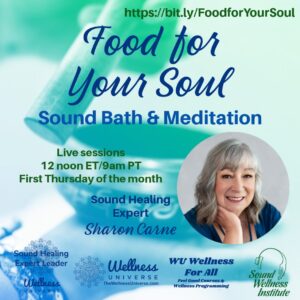
Relax, unwind, and heal with sound in Food for Your Soul. The Wellness Universe invites you to join Sharon Carne, Director of Training and Program Development at the Sound Wellness Institute, for this immersive monthly experience.
Join us live – https://bit.ly/FoodforYourSoul



Jean Voice Dart is a Certified Expressive Arts and Grief and Trauma Coach (CCF), Credentialed Expressive and Performing Arts Teacher (MS), Registered Music Therapist (RMT), and Master Level Energetic Teacher. Those working with Jean identify, embrace, and release blocked feelings and emotions through the creative, expressive, and performing arts. She has over forty years of experience in private and group sessions, helping people triumph over physical, mental, or emotional challenges.