Across the globe, workers in high‑pressure fields face escalating rates of suicide, burnout, and mental health decline. Statistics reveal a widespread crisis in workplace wellness. A conscious effort to practice personal self-care is needed to begin healing ourselves and our world. The stories that follow are real, personal, and deeply reflective of a growing global crisis affecting workers, families, and entire communities. It’s time to save our own lives and the lives of future generations.
The Macho Myth: Construction or Destruction?
I watched him lace up his boots every morning, shoulders squared, jaw set, stepping into a world that demanded toughness at all costs. Construction workers are expected to be strong, silent, unbreakable—the ones who lift, carry, build, and endure. But beneath that macho persona, he carried more than steel, concrete, and wood. He carried the weight of expectations, exhaustion, and unspoken pain.
The fluorescent lights hum softly above us as we sit in the doctor’s office. My husband—a construction worker, carpenter, plumber, and electrician—shifts uncomfortably on the exam table, the thin paper crinkling beneath him. He’s wearing a hospital gown, his shoulders slumped, his hands resting in his lap.
One of the fingers on his left hand bears a deep scar, a severed finger with permanent nerve damage, injured years ago by a circular saw. One shoulder is lopsided from mechanical injuries, and multiple hernia surgeries make him cautious about heavy lifting. His body tells the story of a lifetime of “pushing through.”
The doctor puts his chart down, clears his throat, and looks at him intensely, knowing the news will land hard.
“You’ve given a lifetime to outdoor job sites, and your skin shows it. These aren’t just age spots. These are actinic keratoses—hundreds of them. Your skin has taken all the radiation it can handle.”
My husband silently accepts another burden added to a body already battered by decades of labor. We both listen carefully to the self-care needed as the doctor removes twenty or thirty of them with liquid nitrogen.
“Now, take this seriously. I can sit here all day removing these, but that doesn’t solve the problem. You need to stay out of the sun.”
This is a part of workplace wellness rarely revealed to employers—the quiet, relentless toll on people who build our homes, repair our power lines, and keep our communities functioning.
My husband worked through injuries, fear, and fatigue that settled into his bones.
And he did it because the “macho myth” culture told him that real men don’t complain, don’t break, and don’t ask for help.
But the truth is, this macho myth destroys the men and women it claims to honor.
Construction workers experience suicide rates at nearly four times the national average. Police officers and firefighters are more likely to die by suicide than in the line of duty. Military service members and veterans carry some of the highest burdens of all, with active‑duty suicide rates nearly 25 per 100,000 and veteran rates more than double the civilian rate. Together, these professions—the very ones our culture labels as “toughest”—carry some of the heaviest mental‑health burdens in the workforce.
Jobs associated with the “macho” image—police, firefighters, construction workers, and military workers–continue to be haunted by outdated attitudes of pushing forward through pain. But today, both male and female workers are recognizing the need to dispel the macho myth and embrace self-care.
The Culture That Praises Self‑Sacrifice
Diane wakes before sunrise, moving quietly through her kitchen, packing her bag for another day as a home‑visiting nurse. Her work is sacred and heavy—tending to people nearing the end of life, supporting families who are grieving long before the final breath.
She enters living rooms where hospital beds replace sofas. She holds cool, fragile hands. She listens to whispered fears and final goodbyes. Every day, she absorbs grief—fresh, old, and unspoken—carrying it in her body like a second heartbeat.
When her shift ends, her caregiving doesn’t.
After work, she checks on her aging mother and her disabled sister, Juliette, making sure they are safe, fed, and grounded. She holds their crises just as she holds her patients’ hands.
She cares for everyone, except herself. Her own exhaustion and pain are pushed aside by a cheerful smile and perky presence. She tells herself, “I’ll rest later.”
But later never comes. By the time she slows down, it is too late.
My sister-in-law died in 2002, after receiving the same tender care she gave freely to so many others—listening, loving, and caring.
Her last words reflect the life she lives—a life of unwavering self‑sacrifice, always concerned for others, even with her final breath:
“Promise me you’ll take care of Mom and Juliette.”
“Yes, Diane, we will.”
Her story reveals the heartbreaking cost of a culture that praises self‑sacrifice—a culture that teaches caregivers to give until there is nothing left.
Nurses, physicians, and frontline care providers face some of the highest mental‑health risks in the workforce: female nurses die by suicide at rates nearly twice that of women in the general population, and male physicians die by suicide at rates 40% higher than men overall. EMS workers experience trauma‑related injuries at rates five times higher than the average worker.
Together, these numbers reveal a painful truth: the people who care for us in our most vulnerable moments are often carrying the heaviest, least acknowledged burdens.
Failing the Fragile – A Teacher’s Rescue
The air smells faintly of antiseptic wipes, crayons, graham crackers, and floor wax.
All ten children are communication-challenged. All need something at the same time. All but Shelly use mobility aids, and she is running in circles around the room, her shoes slapping the linoleum in a steady, frantic rhythm. I turn on the music, and we hold hands, dancing to the beat.
Billy pounds on his desk with the flat of his hand.
“Help! Help!” he calls, his voice strained, his face flushed. He needs to be lifted in and out of his wheelchair to go to the restroom.
My aide steps toward him.
“I’ve got him,” she says, already unbuckling his straps.
She wheels him toward the door, and suddenly I’m alone with nine special needs children.
I take a reset breath—deep and quick. There’s no time for more than one. I scan the room to see Ilene working on eye‑hand coordination, carefully pressing oversized puzzle pieces into place.
Marcus is rocking rhythmically and needs sensory input.
As a special education teacher, I must write IEPs, establish baselines, conduct pre‑ and post‑testing, and submit the constant documentation required to fund our program. Modifications to our room and equipment are made from scratch because the building and the curriculum were never designed for these children.
I take another deep breath, the kind teachers take when the world is spinning.
Let’s do this, Jean!
My large cloth bag is full of things the school can’t provide.
I pull out two giant chalk pieces I bought myself. They’re perfect for Jenny’s ulnar nerve palsy. She wiggles in delight as I place it on her wheelchair tray, ready to draw with the other children. Next, I remove two bean bags I stitched at home, filled with lentils—exactly what Ricky and Billy need for sensory stimulation.
Each weekday, I stay for an hour after school, offering my time to parents who need comfort, reassurance, and someone who listens without judgment. Billy’s parents arrive early. His father is unemployed, and they are exhausted, frustrated, and grieving the system. I allow them to vent freely for 10 minutes, then I speak quietly.
“Billy used a spoon yesterday, Mrs. Shepherd. The joy on his face is something I’ll never forget. Here. I picked this up for you. It’s an adapted spoon. It fits his palm perfectly. Please work with him and let me know if you see improvement.”
“Thanks so much, Jean. We definitely will.”
This is the part of teaching the public never sees—the part that doesn’t end when the bell rings. The system has failed our children, and the teachers step up to offer help.
94% of teachers spend their own money on classroom supplies. 40–70% of teachers report significant emotional exhaustion. Special education teachers experience some of the highest rates of burnout and turnover. School counselors and psychologists face rising burnout. Paraeducators experience high emotional strain, and many educators avoid reporting mental‑health struggles due to fear of judgment or job consequences.
So, What Can We Do?
My life as a special ed teacher and psychotherapist has been hugely rewarding and transformational. It filled me with a great compassion for those who work in high-stress jobs, such as my husband and sister-in-law.
Today, Diane is gone, and my husband and I no longer work in a high-stress environment, but I continue to advocate for global health and wellness.
The wellness of our workers is vital to the success and survival of our loved ones, neighbors, communities, and our world. So, what can we do to support our construction workers, police, firefighters, nurses, doctors, wellness professionals, teachers, and others experiencing high-performance stress and worker burnout? What can we do to stop this worldwide workplace crisis?
Worldwide success begins with our own inventory and plan. Together, we can achieve global workplace wellness.
Worker Burnout Survey
Are you ready to save your life? Let’s go! The following is a brief self-assessment and powerful check‑in tool workers can use to recognize early signs of burnout. Please rate each statement from 1–5, add up your score, and learn more about your potential risk for worker burnout.
(1 = Not at all true, 5 = Very true)
- Emotional Exhaustion—I feel drained before my day even begins.
- Compassion Fatigue—I struggle to feel present or available for others, feel numb, irritable, impatient, emotional, or apathetic.
- Physical Warning Signs—I experience headaches, muscle tension, digestive problems, fatigue, trouble concentrating, or sleep disruption.
- Workload Overload—My responsibilities exceed what one person can reasonably manage.
- Boundary Erosion—I say “yes” when I know I need to say “no.”
- Loss of Joy—Activities that once brought meaning now feel like obligations. I’ve stopped having fun or doing what I love most.
- Isolation—I withdraw from friends, coworkers, or loved ones.
- Hyper‑Responsibility—I feel guilty when I rest or take time for myself. I work harder and longer than most people.
- Crisis‑Mode Living—I move from one urgent situation to the next without recovery time.
- Neglected Self‑Care—My basic needs (sleep, nutrition, movement, downtime) are inconsistent or ignored.
Scoring
- 40–50: High risk—consider immediate intervention and support
- 30–39: Moderate risk—seek burnout-prevention strategies now.
- 20–29: Mild risk—strengthen boundaries and self‑care routines.
- 10–19: Low risk—maintain current wellness practices.
Preventing Burnout & Embracing Self‑Care
The following list includes a wide variety of scientifically proven approaches to managing worker burnout. Read through them mindfully and choose those that can be easily worked into your lifestyle.
- Micro‑Rest Practices—Plan short, intentional pauses (60–90 seconds) to reset the nervous system.
- Boundary Rituals—Keep a consistent “end‑of‑shift” routine that signals the body to transition out of crisis mode.
- Body‑Listening—Notice early cues and stop to reset when you notice a tight jaw, shallow breathing, irritability, muscle tension, sleepiness, or fatigue.
- Workload Triage—Sort tasks into urgent, important, and can wait to reduce overwhelm. Review tasks daily and tackle the most urgent. Break tasks down into smaller steps to ensure success.
- Connection Breaks—Brief check‑ins with a trusted coworker or friend to reduce isolation.
- Compassion‑In/Compassion‑Out—A grounding breath practice for those in caregiving roles.
- Scheduled Recovery Time—Schedule one weekly block of time for rest, not productivity.
- Creative Expression—Plan time for art, writing, music, craftmaking, movement, or dramatic play to release emotional residue from the workday.
- Nature Exposure—Schedule at least 10 minutes outdoors daily. This can reduce cortisol and restore cognitive clarity.
- Ask for Help—Reframe stressful life situations. Change your opinion about asking for help. Seeking professional strength is not seen as a weakness.
- Physical Activity—Plan time for safe doctor-approved physical activities, such as stretching, swimming, or walking, to relieve stress and support your body’s unique needs.
Summary: Wellness for Future Generations
Workplace wellness is not a luxury—it is a lifeline. Worldwide depression and anxiety cost the global economy an estimated $1 trillion annually in lost productivity. People are carrying silent burdens: chronic stress, emotional exhaustion, physical injury, and the weight of expectations that no one can sustain alone. The solution to workplace wellness can’t be found in isolation. Workplace owners must partner with employees to reject outdated myths and encourage healthy practices.
You deserve to feel well and enjoy life. Let’s stop this global crisis by applauding wellness efforts among our friends and families, and around the world. Together, we will save our own lives and inspire others to save theirs for the sake of future generations.
Thank you. Your wellness matters, and you are not alone.
Jean Voice Dart
Jean Voice Dart is a Certified Expressive Arts and Grief and Trauma Coach (CCF), Credentialed Expressive and Performing Arts Teacher (MS), Registered Music Therapist (RMT), and Master Level Energetic Teacher. Those working with Jean identify, embrace, and release blocked feelings and emotions through the creative, expressive, and performing arts. She has over 50 years of experience in private and group sessions, helping people overcome physical, mental, or emotional challenges.
Connect with Jean on The Wellness Universe and follow her on Instagram and Facebook.
The Wellness Universe
The Wellness Universe is a safe, supportive community. It provides a directory of health and wellness resources, expert practitioners, and daily or weekly classes and events. Please check The Wellness Universe events page to discover activities, classes, workshops, private sessions, and panel discussions to support your self-care journey.
If you are looking for a community focused on mental health awareness and suicide prevention, please join us at The Wellness Universe’s “Take My Hand Support Series,” every other month, on the second Saturday, at 9 AM PT / 12 PM ET, in the Wellness Universe online lounge. Find out more and register for this free or pay–as–you–can event.
The Emergency and Crisis Resource List
If you or a friend or loved one is experiencing an urgent emotional, physical, or mental crisis and needs immediate comfort or care, please call 988 in the United States for immediate assistance, or visit https://988lifeline.org/ for an online chat. For additional U.S. or international crisis information and a list of emergency resources and contacts, please check The Wellness Universe Emergency and Crisis Resource List at https://www.thewellnessuniverse.com/emergency-and-crisis-resource.
Take My Hand Support Series
Wellness in the Workplace
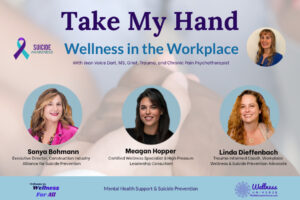
Research shows that workplace wellness is a serious global concern, with rising levels of burnout, emotional exhaustion, and mental health decline across industries. Many employees struggle under chronic stress, long hours, and high‑pressure environments that leave them vulnerable to depression, anxiety, and suicidal ideation. This session addresses these challenges head‑on, offering insight, education, and compassionate support for individuals and organizations seeking healthier ways to work and live.
Join us for “Wellness in the Workplace,” on Saturday, July 11, 2026, hosted by Jean Voice Dart, Psychotherapist, Grief, Trauma, and Chronic Pain Specialist, with guest speakers:
- Sonya Bohmann — Executive Director, Construction Industry Alliance for Suicide Prevention
- Meagan Hopper — Certified Wellness Specialist & High‑Pressure Leadership Consultant
- Linda Dieffenbach —Trauma‑Informed Coach, Workplace Wellness & Suicide Prevention Advocate
Together, they explore workplace stress, mental health, and suicide risk, examining how high‑demand environments contribute to burnout, emotional overload, and feelings of isolation. Our panelists will share evidence‑based strategies, effective resources, trauma‑informed practices, and real‑life examples that provide proven pathways to healing.
You are not alone, and your mental wellness matters.
⏰12:00pm ET/9:00am PT
Register & Join Live: https://bit.ly/WUTakeMyHandSupportSeries
A Transformational Journey Workshops
Unlock the full transformational journey with all 29 powerful workshops!

Reflective Journaling for Love
with Jean Voice Dart
Discover The Dream Mirror: Reflective Journaling for Loving Relationships from the Amazon #1 best-selling book, The Wellness Universe Guide to Complete Self-Care: 25 Tools for Transformation. This transformative tool helps you release blocks, deepen self-love, and create lasting, healthy relationships.
COMING SOON!
The Wellness Universe Guide to Complete Self-Care:
25 Tools for Navigating Loss, Grief and Transition
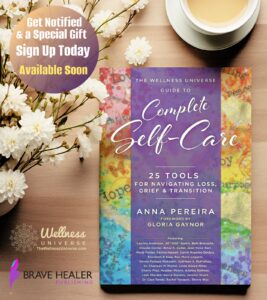
The Wellness Universe Guide to Complete Self-Care, #1 Bestselling book series brings more well-being support to you soon. 25 Tools for Navigating Loss, Grief & Transition available soon. Sign up now for free gifts and win a prize in our Mega Wellness Prize Bonanza – Over $20,000 in prizes & everyone will win:
👉 Join Our Launch Team & Win Prizes



Jean Voice Dart is a Certified Expressive Arts and Grief and Trauma Coach (CCF), Credentialed Expressive and Performing Arts Teacher (MS), Registered Music Therapist (RMT), and Master Level Energetic Teacher. Those working with Jean identify, embrace, and release blocked feelings and emotions through the creative, expressive, and performing arts. She has over forty years of experience in private and group sessions, helping people triumph over physical, mental, or emotional challenges.


Jean, this is such a powerful and compassionate article. Thank you for shining a light on the silent burdens so many people carry in professions that often reward self-sacrifice while overlooking self-care. Your personal stories made the statistics deeply human, and your practical burnout assessment and wellness suggestions offer hope and action. May this important message inspire both workers and employers to recognize that caring for ourselves isn’t a luxury; it’s essential for ourselves, our families, and future generations. Beautifully written.