
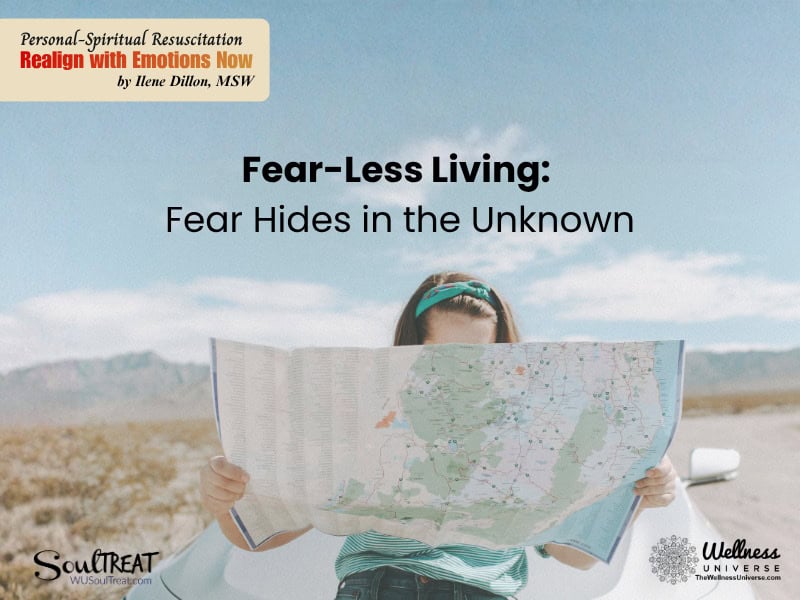
After more than five decades as a practicing psychotherapist, I’ve come to a conclusion that may sound deceptively simple: fear doesn’t come from what we know—it comes from what we do not know. Fear hides in the unknown.
Again and again, I’ve watched people—my clients, my colleagues, and myself—pull back, hesitate, or completely shut down, not because something dangerous was actually happening, but because something might happen. The mind, in its efficiency and habit, tends to rush toward the negative. Whether that’s by design or conditioning, the result is the same: when we step into unfamiliar territory, the brain fills in the blanks with worst-case scenarios.
And so, we avoid.
We avoid the conversation.
We avoid the decision.
We avoid the risk.
We avoid standing up for ourselves.
Fear becomes the gatekeeper of our lives—not because it’s accurate, but because it is persuasive.
The Personal Roots of Fear
My understanding of fear is not merely professional. It is deeply personal.
As a child, I learned very early that disagreeing could be dangerous. If I even mildly contradicted what my father declared to be true, I could be slapped across the face. Not for defiance, not for rebellion—simply for having a different perspective.
That experience shaped something fundamental inside me. It taught me, at a very young age, that speaking up carried consequences. Painful ones. Immediate ones. Unpredictable ones.
So what happens to a child who learns that?
She grows into an adult who hesitates.
Even when no one is there to slap her.
Even when she has every right to speak up.
Even when her voice matters.
Because fear is not just about what is happening—it is about what might happen, based on what has happened before.
If I were to stand up for myself as an adult, there are several “unknowns” my mind would automatically generate:
- Will I be rejected or dismissed?
- Will the other person become angry or retaliate?
- Will I lose the relationship or connection?
- Will I be emotionally hurt again in a way I cannot control?
Notice that none of these are certainties. They’re possibilities. Unknowns. Yet the body and mind can react as if they are real.
That is how fear operates.
Fear as a Tool for Control
Because fear is rooted in the unknown, it becomes a powerful tool—not only internally, but externally. It can be used to control behavior with remarkable effectiveness.
Let me offer three examples.
1. Workplace Control
Michael works in a corporate environment where his supervisor, Linda, frequently says things like, “People who question leadership decisions don’t tend to last long here.”
Michael has ideas—good ones—but he keeps them to himself. Why? Because the unknown looms large: Will I lose my job? Will I be targeted? Will I be seen as difficult?
Linda doesn’t need to fire Michael. She doesn’t even need to directly threaten him. She simply creates an atmosphere where the unknown consequences feel dangerous.
And so, Michael complies.
2. Relationship Control
Sara is in a relationship with Daniel, who becomes distant and cold whenever she expresses dissatisfaction. He does not yell. He does not argue. He withdraws.
Sara begins to associate speaking up with emotional abandonment. The unknown becomes: Will he pull away again? Will I be left alone?
So she stops bringing up her needs.
Daniel controls the dynamic—not through force, but through fear of the unknown outcome.
3. Family Control
James grew up in a household where expressing emotion was met with ridicule. As an adult, his mother still says, “Don’t be so sensitive—it’s embarrassing.”
Now, even in other relationships, James hesitates to share his feelings. The unknown: Will I be humiliated? Will I be seen as weak? Will my worth as a man be questioned?
The control persists long after the original environment.
How Fear as Control Works
In each of these examples, control is not exerted through constant punishment. It is sustained through anticipation. The individual fills in the unknown with imagined negative consequences, often based on past experiences.
Control works because the fear feels real—even when the outcome is uncertain.
Fear as a Tool for Manipulation
Fear can also be used more deliberately, as a means of manipulation—guiding someone’s behavior for another’s benefit.
1. Financial Manipulation
Ellen’s partner, Mark, often says, “If you leave me, you’ll never make it financially on your own.”
Because repeated statements start to become “truth” in our brains, Ellen begins to doubt her own capability. The unknown becomes overwhelming: Will I be able to survive? Will I fail?
Mark reinforces fear to keep Ellen dependent.
2. Social Manipulation
David’s friend Carla frequently warns him, “If you say that to people, they’ll think you’re arrogant and stop liking you.”
David begins to censor himself. The unknown: Will I lose my social circle? Will I be rejected?
Carla shapes David’s behavior by amplifying his fear of social consequences.
3. Professional Manipulation
Nina’s colleague Tom tells her, “If you bring that concern up in the meeting, it could backfire badly on you.”
Nina, uncertain of what “backfire” means, imagines the worst: embarrassment, criticism, even job loss.
Tom’s vague warning manipulates Nina into silence.
How Fear as Manipulation Works
Manipulation leverages ambiguity. It introduces or exaggerates unknown outcomes, allowing the imagination to do the rest.
Unlike direct control, manipulation often disguises itself as advice, concern, or expertise. But the mechanism is the same: amplify the unknown, and fear will do the work.
Facing Fact: The Road to Freedom
Many years ago, I was introduced to a concept by East Indian Yogi Dr. Kaushik called Facing Fact. At its core, Facing Fact means looking at a situation straightforwardly and truthfully—without distortion, without projection, without the opinions of others, and without the embellishments of fear.
He described it as the road to freedom.
And I have found that to be profoundly true.
Fear thrives in the unknown. But when we bring facts into the light, the unknown begins to shrink.
Let’s revisit our earlier examples.
- Michael might discover that others who spoke up were not fired at all.
- Sara might see that Daniel’s withdrawal is a pattern she can name and address.
- Ellen might examine her actual financial resources and capabilities and confidently manage financially.
Facing Fact does not guarantee a perfect outcome. But it removes the imagined catastrophes that fuel fear.
It erodes fear at its foundation.
Four Steps to Facing Fact
Facing Fact can be practiced in a simple, structured way:
- Notice the Fear
Become aware of what you are feeling. Fear often shows up as hesitation, anxiety, or avoidance. - Identify the Cause
Ask yourself: What am I afraid will happen? Name the unknowns clearly. - Search for the Truth—the Facts
What do you actually know? What evidence do you have? What is real, and what is imagined? - Apply the Truth
Act based on what is true—not on what is feared. Let facts guide your response.
What Happens to Fear’s Energy?
When you practice Facing Fact, something remarkable happens to the energy of fear.
It dissipates.
Not always instantly, and never completely (because fear is energy, which cannot be created or destroyed)—but consistently.
Fear, when left in the realm of the unknown, builds and intensifies. It feeds on itself. But when it is brought into the light of truth, it has less to attach to.
It loses momentum.
What once felt overwhelming begins to feel manageable. What once felt paralyzing starts feeling like a choice.
The Gifts of Entering the Unknown
When we allow ourselves to step into the unknown—while Facing Fact—we discover something important: the unknown is not inherently dangerous. It is simply unfamiliar.
There are profound benefits to this shift.
1. Expanded Freedom
You are no longer confined by imagined outcomes. Choices become available that were previously hidden behind fear.
2. Increased Self-Trust
Each time you face the unknown and respond with truth, you build trust in your own capacity to handle life. Trust becomes your foundation.
3. Authentic Expression
You begin to speak, act, and live in alignment with what’s true for you—not what fear dictates.
And with these benefits come new emotional experiences:
Relief.
Clarity.
Strength.
Even joy.
A quiet, steady sense of peace replaces the constant vigilance of fear.
Living Fear-Less
I do not mean that fear disappears entirely. That cannot happen. It means fear no longer runs the show.
After 54 years of practice—both professionally and personally—I can say that I now experience life as largely “fear-less.” Not because nothing uncertain ever arises, but because I no longer mistake the unknown for danger.
I meet it with
- curiosity instead of avoidance
- facts instead of imagination
- presence instead of projection.
Fear-Less Living is not about eliminating fear. It’s about understanding and working with it.
Fear hides in the unknown.
Bring in the truth—and it has nowhere left to hide.
Connect with Ilene Dillon on The Wellness Universe, and follow her on LinkedIn and Instagram.
A Transformational Journey Workshops
Unlock the full transformational journey with all 29 powerful workshops!

Strengthen Yourself with Principle
with Ilene Dillon, MSW
Join Ilene’s transformational session designed to help you navigate change and consciously reassemble your life after disruption. Inspired by Chapter 15, “Putting Humpty Dumpty Together: Reassembling Life as You Want It,” this class introduces three powerful tools—Facing Fact, Choosing Principle, and Paying Attention to What You Want to Become. Through guided reflection and practical insight, you’ll discover how change can become a gateway to clarity, smoother relationships, and lasting personal transformation.
Catch the Recording Here
#1 BEST SELLER AVAILABLE NOW!
The Wellness Universe Guide to Complete Self-Care, 25 Tools for Transformation
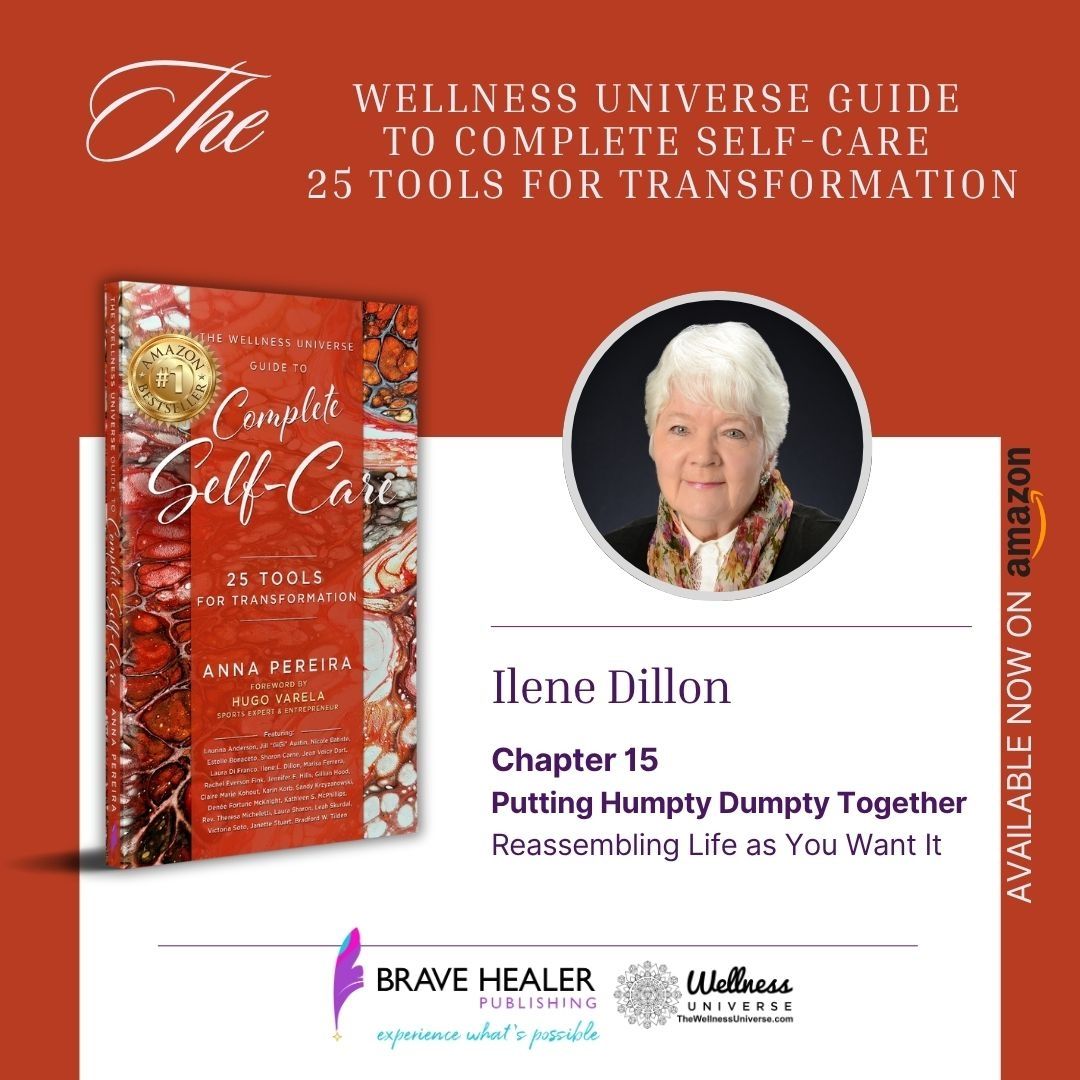
Ready for a gentle reset with real momentum? The Wellness Universe Guide to Complete Self-Care: 25 Tools for Transformation is a 5-star Amazon favorite, and readers say,
“This book should be your bedside table guidebook.”
Open to any page, choose a tool, and let one small shift become your next breakthrough.
A Magical Journey Workshop
with Ilene Dillon

Co-Create Your Best Life
Join Ilene and experience the following:
– Understanding Life’s Challenges in a way that makes sense and leads us to more fulfillment.
– Direct coaching and support for volunteers, helping you to have a direct and supported experience of this tool. For those watching but not participating directly, you will also have experience through watching and listening, giving you relief, understanding and a new way forward.
– Experiencing and feeling the power of one of the Four Main Pillars of Self-Esteem, which we will activate (and show you how
Watch the Recording Here
Get the bundle and save! Lifetime Access to the recordings!
Register Now and Watch the Recordings: https://bit.ly/AMJWorkshops



Ilene Dillon, MSW, developer of Emotional Realignment, is a Transformation Specialist who helps people understand and use emotions as they are designed to work for us, resolving personal challenges at their root and consciously designing life as they want it to be. With more than 50 years as a psychotherapist, marriage and family counselor, coach, and master teacher, Ilene brings decades of experience guiding individuals toward emotional clarity, healing, and transformation. She is a global speaker, podcast host and guest, and a multiple Amazon International and National #1 bestselling author, including Emotions in Motion: Mastering Life’s Built-in Navigation System, End Manipulation: Stop Being Jerked Around by Toxic, Energy-Draining People, and contributor to The Wellness Universe Guide to Complete Self-Care (Volumes 1, 2, 3, 5 and 6). Traveling full-time in her RV, Ilene writes, teaches, and speaks across North America, sharing practical tools that empower people to reclaim their power, navigate change, and create the life they truly want.


Ilene, your article held excellent examples that were relatable, insightful, and filled with wisdom that encourages greater self-trust, freedom, and authentic living. Thank you for sharing this meaningful reminder that fear does not have to lead the way.
Such a great article Ilene and thank you for awareness around manipulation and fear. Living life as fearless is blissful!
Truly insightful and helpful article, Ilene. Your examples clearly illustrated the way fear and manipulation can stop people from living the lives they want and deserve. Thank you for pointing out that fear is often imaginary and can be conquered by truth.