
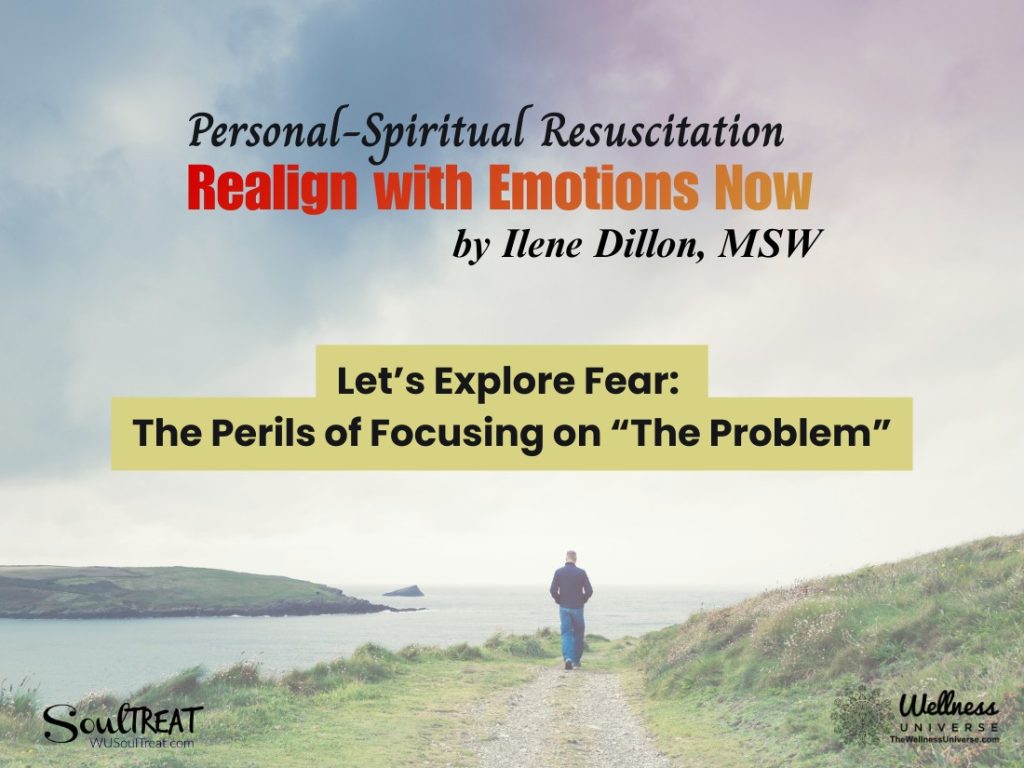
“When did my fear begin?”
“What kind of help did I get with my fear?”
“How did my parents handle their fear?”
“What was I told about fear? Everybody has fear, don’t be afraid, just keep going—be brave, get over it!”
“Why don’t I know how to get rid of fear? Can I get rid of it?”
“I’m afraid not to be afraid. Something worse could happen!”
“Fear could sneak up on me and ruin my life—I’m staying guarded.”
Everyone experiences fear. Not always fear about the same things, or to the same extent—but we all know what fear is.
When we go to deal with it, we ask ourselves, and others, questions like these. We’re taught to focus on questions about “the issue,” believing the way to “get over” something is to figure out its cause, duration, history, and the blockages we can find in ourselves that keep us from moving away from fear.
In short, we’re taught to focus on The Problem. Where did my problem come from? How long has it been operational? What am I doing wrong to cause this problem to continue? Whose fault is this problem? What do others say I need to do to overcome this problem? Is there an action, or a pill, I can take to get rid of this problem? Are there professionals who can tell me how to overcome this problem?
In recent years, a popular phrase is repeated when looking at “the problem.” That phrase is: “It’s not your fault.” I don’t believe in fault. I do, however, believe in responsibility. Even if a problem is “not your fault,” it is your responsibility to deal with it, if only for the fact it is occurring in your life!
To understand “the problem with focusing on the problem,” let’s focus on the operant principle:
Whatever we focus on, we feed energy to, and it grows.
In other words, by focusing on fear as “the problem,” fear grows (and becomes more of a problem)!
Focusing attention on “the problem” makes the work of dealing with fear more challenging, blocking its full release, taking more of your time, and making a big challenge to your ability to succeed in dealing effectively with fear.
Additionally, focusing on the fear as “My Fear” makes the problem more persistent and more likely to be difficult to eradicate. Why is this?
Because emotions, including fear, are energy. Energy cannot be created; it cannot be destroyed. Energy needs to move. When energy moves, it can be transformed into other types of energy, even while it cannot be “gotten rid of.”
These same “rules” govern fear. We cannot create it, destroy it, or get rid of it—but we can transform it into another type of energy.
Therefore, when working with fear, we need to accept that we’re experiencing fear, that fear exists. We also need to know we cannot destroy (get rid of) fear, that fear needs to move, and that the energy of fear can be transformed into another form of energy, such as courage (which some people define as “feeling fear and taking action anyway”).
So why not state that it’s “my fear”? When we claim fear as “mine,” we hold onto it. It can’t move. We “own” fear, bind it to ourselves. As a result, it’s difficult to release. Fear’s energy cannot dissipate and move on.
Instead of calling it “my fear,” please consider noticing fear and reporting it as “the fear I’m experiencing,” “the fear that arose in me,” or “the fear I noticed myself feeling.” These descriptions of fear do not claim fear as our personal possession. Instead, fear exists; fear showed up. It’s energy that has come up, yet is still free to move through us, and onward.
This is very important. Using “my” with anger, fear, jealousy, guilt, depression, or terror sets you up to hold onto the very emotions most of us say we want to release and move away from! Consider changing your patterns of verbal description!
What’s the problem with focusing on the problem?
There is nothing “wrong” with focusing on the problem.
The issue is that by focusing on the problem, the problem tends to grow. When it grows, it takes more effort and more time to resolve. Most often, without realizing it, we make our lives more difficult because the “problem” gets larger.
At age 28, I lived alone with my year-old daughter. In the previous 18 months I had moved into a home new to me, had a baby, been deserted by my husband (who decided after the child was born that he wasn’t ready to be a father), and returned to graduate school. I now lived alone with my child in a house on one acre of land, with 22 fruit trees, perched above town on a hill.
At that point in my life, I had never had my own room, much less an entire house that I lived in alone, albeit with a little child. I was really scared to live alone.
To compound my fear, I started receiving obscene phone calls! I didn’t know how to deal with them, and chose to do all the wrong things. Night after night I stared the dark ceiling, felt terrified because I was in a new home and had no idea where these calls were coming from, had a very young child to protect, and didn’t know much about protecting myself. I waited for the phone’s ringer to sound, knowing it would occur.
Night after night.
After a couple of weeks, I started feeling really angry about my situation. Not only had I been deserted, had everything to do myself, had no support, knew no one who lived nearby, now I had someone calling to harass me with obscene phone calls! That anger muscled out some of the fear I was feeling.
One night, I went to my living room and had a talk with God. “I’m afraid, God. I can’t do this all by myself. I don’t know what to do; and I have no one to protect us. I don’t want my little child to die a violent death. I don’t want to die a violent death, either. I need your help. Please help me!”
I felt a little better. But wait—there was more. “And God,” I continued, “I’m doing a lot in my life. I don’t have time to keep vigilant about this! Truth be told, I don’t want to die at all. I understand I have to accept that I will die, but in the meantime, I don’t want to keep looking over my shoulder for obscene callers I can’t even recognize. So, God, I’m turning this over to you. You take care of us and keep us safe. I’m now relying on you, turning the whole matter over to you!”
I immediately felt so much better. I returned to my bed and fell asleep.
Unknowingly, I had discovered a new focus for my energy—on how I wanted things to be, instead of focusing on the problem!
Eventually, I coined a phrase, which I used for years as my podcast sign-off:
Pay attention, not to what you want to overcome, but to what you want to BECOME.
Following this “rule” allowed me to focus my attention on the solution, rather than on the problem. It worked because my focused energy was causing the “solution” to grow, instead of the “problem.”
It worked. I shared my fear with my estranged husband, who told me the steps to end the obscene calls. His advice was effective. Our lives continued less disrupted, and safer.
Whenever we focus on “the fear” and “the problem of the fear,” we allow fear to increase, to gain strength and influence over our lives.
Whenever we focus on the “what I want to become,” we allow our more powerful self to increase, building new patterns and supporting actions that are stronger.
This is most important to keep in mind when dealing with fear. Working with fear this way can allow us to sidestep a lot of fear we would otherwise experience, keeping ourselves calmer and enjoying more “positives” in our lives.
The next time you notice you’re feeling afraid
- Allow yourself to acknowledge and feel it.
- Recognize that fear is alerting you that you’re moving into “unknown territory,” reminding you to “exercise care and caution.
- Decline the invitation you hear in your head to “focus on the problem.”
- Instead, start formulating what you’d prefer to pay attention to, or do, now that you notice the fear.
- To the best of your ability, give yourself permission to take those steps. You may need to take baby steps and not do all of it at once, but do something new that supports your plan!
- Savor your new action. Notice if you feel different. Be grateful to yourself for your courage and new action.
It’s been more than 50 years. My daughter and I are both still alive!
It doesn’t really matter whether it was God who created this circumstance, or it was the way things were going to work out on their own! What really matters is that I didn’t allow myself to stay fearful, all this time!
I want all of us to know we don’t need to stay fearful. We can develop “Fear-less Living,” putting ourselves in charge of fear instead of living in its merciless grip.
We come to this earth to learn and grow. Learning involves developing understanding, taking new steps, and moving forward. Fear operates to stop us in this progress.
Fear acting that way just makes our learning take longer and our lives more difficult. Fear we’re not in charge of robs us too much of great experiences and great lives.
If you still hold yourself back by entertaining and nourishing fear, I’m glad you’re reading these blogs about what you can do differently. Please let me know your reactions, and just how my story is helpful to yours. Thanks.
Connect with Ilene Dillon on The Wellness Universe, and follow her on LinkedIn and Instagram.

“Outgrowing Manipulation: Step Two for Claiming Ourselves as Energy Beings”
Join Ilene for an enlightening session designed for anyone who finds manipulation showing up in their life. Together, you’ll explore five essential questions—what manipulation is, why it appears, whether it serves a purpose, and how to bring it to an end. Through real-life stories, fresh perspective, and practical tools, Ilene invites you to outgrow manipulation and reclaim your personal power. You’ll leave with greater clarity, usable insights, and a clear next step forward.
📅 APRIL 29 |⏰ 9:30 – 10:30 AM ET
WHERE: WU SoulTreat, VEDA HALL 1
Register Now
A Transformational Journey Workshops
Unlock the full transformational journey with all 29 powerful workshops!

Strengthen Yourself with Principle
with Ilene Dillon, MSW
Join Ilene’s transformational session designed to help you navigate change and consciously reassemble your life after disruption. Inspired by Chapter 15, “Putting Humpty Dumpty Together: Reassembling Life as You Want It,” this class introduces three powerful tools—Facing Fact, Choosing Principle, and Paying Attention to What You Want to Become. Through guided reflection and practical insight, you’ll discover how change can become a gateway to clarity, smoother relationships, and lasting personal transformation.
Catch the Recording Here
#1 BEST SELLER AVAILABLE NOW!
The Wellness Universe Guide to Complete Self-Care, 25 Tools for Transformation
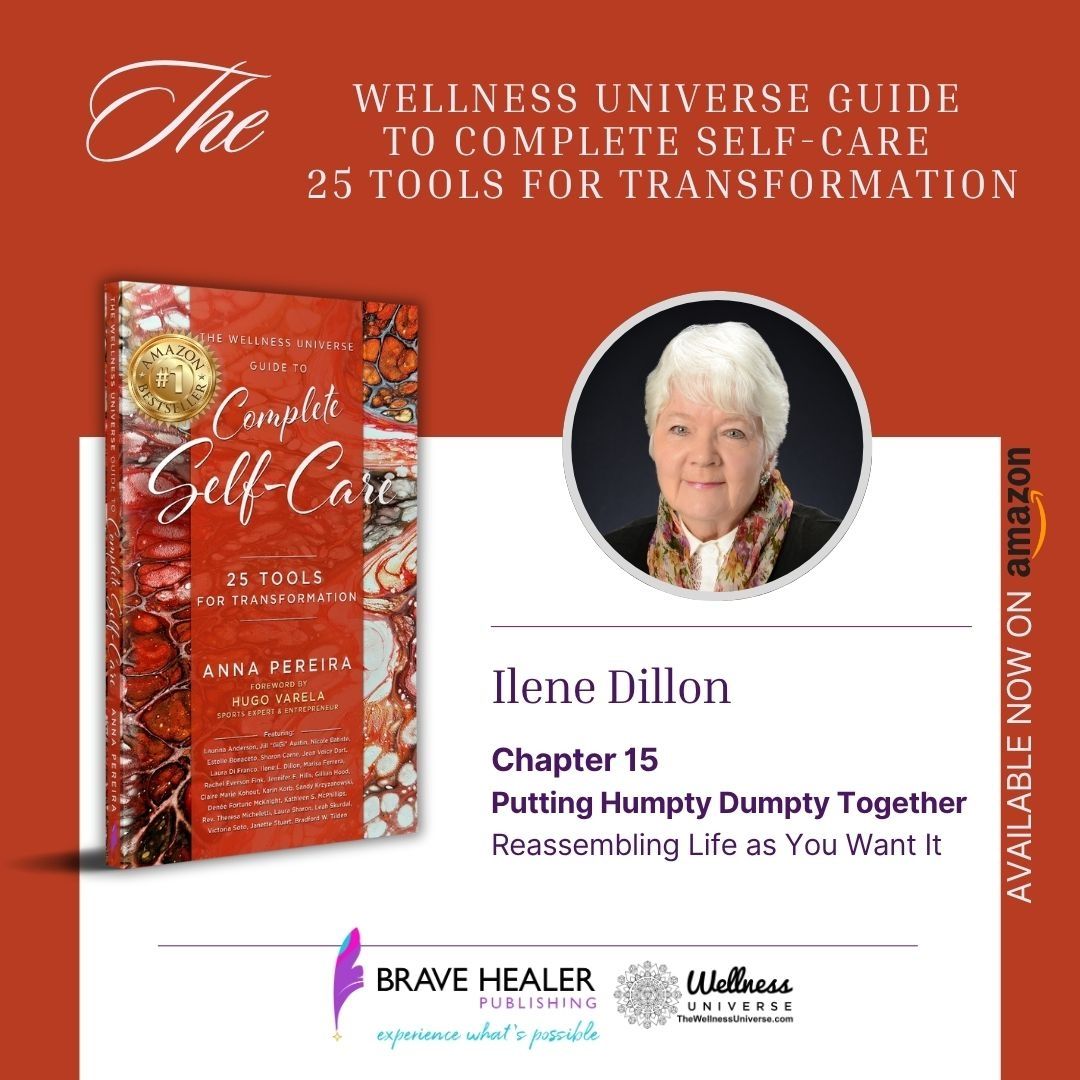
Ready for a gentle reset with real momentum? The Wellness Universe Guide to Complete Self-Care: 25 Tools for Transformation is a 5-star Amazon favorite, and readers say,
“This book should be your bedside table guidebook.”
Open to any page, choose a tool, and let one small shift become your next breakthrough.
A Magical Journey Workshop
with Ilene Dillon

Co-Create Your Best Life
Join Ilene and experience the following:
– Understanding Life’s Challenges in a way that makes sense and leads us to more fulfillment.
– Direct coaching and support for volunteers, helping you to have a direct and supported experience of this tool. For those watching but not participating directly, you will also have experience through watching and listening, giving you relief, understanding and a new way forward.
– Experiencing and feeling the power of one of the Four Main Pillars of Self-Esteem, which we will activate (and show you how
Watch the Recording Here
Get the bundle and save! Lifetime Access to the recordings!
Register Now and Watch the Recordings: https://bit.ly/AMJWorkshops
SoulTreat Retreat 2026
April 28 – May 1
Give yourself the gift of loving self-care. Come to SoulTreat!

 The therapeutic retreat you need!
 Take me to SoulTreat
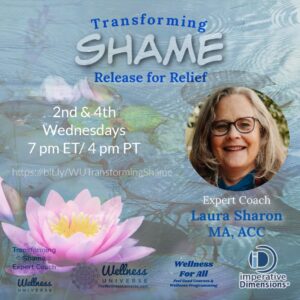
Transforming Shame: Release for Relief
Shame can quietly shape our thoughts, relationships, and self-worth. Left unaddressed, it can hold us back from living with confidence, connection, and peace. This 6-month, 12-session live online course helps you understand shame, release its grip, and cultivate self-compassion through practical tools, mindfulness practices, and guided reflection.
Session 5 – Rewrite Your Story
Identify the role of self-talk in shaping shame. Discover tools to shift toward kindness and self-support.
👉 Enroll Now: https://bit.ly/WUTransformingShame



Ilene Dillon, MSW, developer of Emotional Realignment, is a Transformation Specialist who helps people understand and use emotions as they are designed to work for us, resolving personal challenges at their root and consciously designing life as they want it to be. With more than 50 years as a psychotherapist, marriage and family counselor, coach, and master teacher, Ilene brings decades of experience guiding individuals toward emotional clarity, healing, and transformation. She is a global speaker, podcast host and guest, and a multiple Amazon International and National #1 bestselling author, including Emotions in Motion: Mastering Life’s Built-in Navigation System, End Manipulation: Stop Being Jerked Around by Toxic, Energy-Draining People, and contributor to The Wellness Universe Guide to Complete Self-Care (Volumes 1, 2, 3, 5 and 6). Traveling full-time in her RV, Ilene writes, teaches, and speaks across North America, sharing practical tools that empower people to reclaim their power, navigate change, and create the life they truly want.


Ilene, I love the gentle shift you invite us to make from focusing on the problem to focusing on who we are becoming. That perspective brings such hope and empowerment. Thank you for sharing your story so openly and for reminding us that courage can grow when we place our attention on the life we wish to create. Your words are a beautiful encouragement to keep moving forward with faith and grace.