

You told yourself you’d rest after the launch. That was three launches ago.
Then you said you’d rest after the quarter closed. Then after the team was hired. Then after the kids went back to school. Then after the holidays. Then after the other holidays.
“Later” has become the most productive word in your vocabulary. It’s done more work than your entire project management system—because it’s single-handedly kept you from questioning the pace that’s quietly unraveling you.
And honestly? You did rest. Sort of. You took the long weekend. You binged a series. You even went on vacation—and only checked your email four times a day instead of fourteen.
Progress, right?
Except you came back exactly the same. Same pace. Same dread. Same 2 AM ceiling-staring. Same white-knuckle grip on everything.
So here’s the question you’re avoiding: if you keep resting the way you’ve been resting, and you keep arriving back at the same exhaustion—is that rest? Or is that just a longer runway before the same crash?
The Internal Monologue of “I’ll Deal With It Later”
See if you recognize yourself in any of these. (Spoiler: you will.)
The practitioner version: “I just poured into six back-to-back client sessions, and now I’m eating cereal over the sink at 9 PM, wondering why I have nothing left. But it’s fine. I’ll process my own stuff this weekend.”
(Weekend arrives. You process nothing. You nap like it’s an Olympic sport and call it self-care.)
The entrepreneur version: “If I can just get through this launch, I’ll take a real break. I know I said that about the last launch. And the one before that. But this time is different because I’ve added a project management tool, so clearly my systems are evolving even if my sleep schedule hasn’t.”
The corporate leader version: “I have 47 unread messages, three direct reports who need decisions before noon, a board deck due Thursday, and a partner at home who’s stopped asking how my day was because the answer is always the same sigh followed by ‘fine.’ But I used my vacation days! I mean, I worked through most of them. But I was in a different time zone, so that counts.”
Different titles. Same exhaustion. Same lie: “I just need to get through this stretch.”
That stretch has been going on for years. Seriously, your morning routine has a morning routine. And your idea of “slowing down” is answering emails from the couch instead of the desk.
The Recovery Trap
So here’s the thing. Something inside you knows you’re running on fumes. You’re not oblivious. You feel the fatigue, the flatness, the creeping resentment toward things you used to love. So you do the “responsible” thing. You rest.
But the rest you’re taking is recovery—not recalibration. And that’s where the trap closes.
Recovery is collapsing at the end of the week, recharging just enough to white-knuckle through another one. You come back with a fuller tank—and pour it straight into the exact same system that drained it. Like filling up your gas to drive the same route that keeps ending at a cliff.
Recalibration is pulling over and asking: Why does every route I take end here?
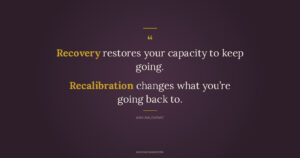
Recovery restores your capacity to keep going. Recalibration changes what you’re going back to and how you engage with it.
In life, the Recovery Trap looks like taking a spa day and returning to the same punishing household schedule you built. Booking the vacation but spending it performing relaxation while your nervous system stays on high alert. Sleeping in Saturday and filling Sunday with everything you “missed.” You’ve turned resting into another item on the to-do list. With a time limit.
In business, it’s the same pattern in professional clothing: taking the long weekend but returning to the same unsustainable client load. Using your PTO but never actually stepping out of the decision-making loop. Going on retreat and coming back to a system that requires you to burn out all over again.
Same pattern. Different rooms. The squeeze-harder model is broken—and recovery without recalibration is just the squeeze-harder model with a face mask on.
The Moment I Realized I’d Rebuilt the Same Cage
After fifteen years in capital markets—fibromyalgia, chronic fatigue, the whole spectacular crash—I walked away from finance and built a coaching practice. From scratch. And it worked. My calendar was booked months out. Revenue was consistent. From the outside? I was finally doing it right.
Except I was completely maxed out.
I was offering one-on-one hourly sessions, moving from client to client to client, navigating deep emotional work with zero breathing room between sessions. No space for integration. No structure for the moments between our calls when life actually happened, and the patterns resurfaced. My clients would hit a wall, stay stuck until our next appointment, and a handful only reached out in crisis mode—we’d do the work, they’d feel better, and then… gone until the next emergency.
I was being a band-aid. Offering relief instead of resolution.
And here’s the part that actually broke me open: I realized I was borrowing time from my daughter’s childhood to be available to everyone else.
Missing bedtime. Missing playtime. Physically there, mentally still carrying client sessions that hadn’t had space to land.
I’d left the Capital Markets to stop sacrificing my life for my career. And I’d rebuilt the exact same pattern—just with crystals on my desk instead of stock tickers. Same cage. Nicer curtains.
That was my Recovery Trap in action. I’d been recovering from the pace — weekend naps, the occasional day off, strategic caffeine—without ever questioning the structure that made the pace unsustainable.
So I stopped offering one-off sessions. Restructured everything around deeper programs where I could actually support lasting transformation—not emergency band-aids. My calendar cleared. I panicked. And then the clients who came in were more invested, got deeper results, and stopped needing me to be on call for every crisis.
And I got my evenings back. Not as a reward. As a recalibration.
The Part Nobody Wants to Say Out Loud
Here’s the provocation: the reason you keep choosing recovery over recalibration isn’t that you don’t know the difference. It’s that recalibration requires you to look at something you’d rather not.
Recovery lets you keep the story. The narrative that you’re strong, capable and needed. That the pace is temporary. That it’ll ease up after this next phase. Recovery is comfortable because nothing has to change except your energy level.
Recalibration asks one harder question: What if this pace isn’t a season—it’s a pattern? What if the exhaustion isn’t the price of your ambition, but the cost of an operating system that was installed long before your career started—one that says the only acceptable speed is all of it, all the time?
You know who else keeps that schedule? People in survival mode. The difference is that they don’t have a choice. You do. You’re just running a pattern that’s convinced you otherwise.
That’s not resilience. That’s resignation. And that pattern—the one that says rest is earned, not given—it wasn’t yours to begin with. You inherited it.
The Ripple You Can’t See (But Everyone Around You Can)
When you run in recovery-mode-only, it doesn’t stay in your lane. It leaks. And you already feel it, even if nobody’s said it out loud.
Your team gets the version of you that’s technically present and energetically absent. You’re reactive where you used to be strategic. Short where you used to be curious. They’ve started walking on eggshells—not because you’re unkind, but because your bandwidth is so thin that a printer jam registers as a five-alarm fire.
Your family gets the leftovers. You’re at the dinner table, mentally rewriting the project plan. On the weekend getaway, checking messages in the bathroom. (They noticed. They just stopped saying anything.) That silence looks like acceptance. It’s not. It’s grief.
Your clients—or if you’re a practitioner, the humans sitting across from you—can feel the difference between someone creating from overflow and someone running on fumes. They may not name it. But the quality of your attention, your patience, your ability to actually see them instead of just getting through the session? That’s the first casualty of depletion. And no amount of caffeine fixes it. Trust me, I’ve run that experiment.
The Difference That Changes Everything
This is where people expect me to say “take more baths,” and I’m not going to insult your intelligence like that. You don’t have a bubble bath deficiency.
What changes this is learning to tell the difference between the two kinds of pause—and choosing the one that creates a different result, not just a delayed version of the same one. That’s energetic alignment, and it’s not about doing less. It’s about operating from a completely different place.
Recovery asks: “How do I recharge so I can keep going?”
Recalibration asks: “What needs to change so I stop arriving here depleted?”
Recalibration doesn’t require a sabbatical. It requires one honest moment—could be in the car before you walk in the door, could be in the shower before the day hijacks you—where you ask yourself: Am I building from overflow, or am I building from pressure?
(If you’re answering that while simultaneously scanning a Slack message, that’s your answer.)
If the answer is pressure, the next step isn’t to try harder. It’s to look at the pattern that’s keeping you there. Because that pattern didn’t start with your current schedule. It started long before. And once you see it, you can’t go back.
You don’t need a longer vacation.
You need to build a life you don’t need an escape from.
The Two-Question Check-In (Do This Right Now)
Pull up your calendar from last week. Look at it like a friend would, someone who loves you and has no stake in your productivity.
- Question 1: What on here fueled me—and what drained me? Not “what was important.” What actually left you more alive versus more hollow?
- Question 2: After my last “rest”—my last weekend off, last vacation, last face-down-on-the-couch recovery attempt, did I come back and change anything? Or did I come back and reload the same system?
If the answer to Question 2 is “I reloaded the same system”, congratulations, you’ve identified the trap. That’s not a character flaw. It’s a pattern. And patterns, once you see them, become a map.
Listen. My first attempt at “work-life balance” was colour-coding my breakdowns. Tuesday at 3 PM: existential crisis. Friday at 5: question all life choices. I was so committed to efficiency that even my emotional collapses had calendar invites. (My nervous system was not impressed.)
I can laugh about it now. I couldn’t then.
And here’s what that distance taught me: “Later” is the most expensive lie ambitious people tell themselves. Not because rest is a luxury. Because the kind of rest you choose determines whether you come back different—or just come back.
You didn’t build your career, your practice, your life to spend it all depleted. You built it to create freedom, impact, and prosperity without compromise.
That’s not a someday goal. That’s a right-now decision.
If you’re reading this thinking, “Okay, but which pattern is actually running my version of this?”, that’s the right question. And it’s answerable. The Breakthrough Blueprint Assessment takes two minutes, identifies which pattern is creating your ceiling right now, and shows you where to start.
Because the answer was never to rest later.
It’s to recalibrate.
Connect with Anik on The Wellness Universe and follow her on Facebook and YouTube.
NOW AVAILABLE
SoulTreat Living My Magical Life Magazine

Grab Your Free Copy Here
Ticket Sales Closed
SoulTreat Retreat 2026
April 28 – May 1
Give yourself the gift of loving self-care. Come to SoulTreat!

 The therapeutic retreat you need!
 Explore SoulTreat
A Transformational Journey Workshops

Ready for growth, healing, and inspiration?
Dive deep into the very tools and insights shared by our expert authors in The Wellness Universe Guide to Complete Self-Care, 25 Tools for Transformation! Brought to life in engaging, interactive workshops designed to empower and inspire you. Each author leads a workshop built around the
unique strategies they’ve contributed to this book, giving you firsthand
access to the wisdom behind the pages.
👉 Register here: https://bit.ly/ATJWorkshops
#1 BEST SELLER AVAILABLE NOW!
The Wellness Universe Guide to Complete Self-Care, 25 Tools for Transformation

Ready for a gentle reset with real momentum? The Wellness Universe Guide to Complete Self-Care: 25 Tools for Transformation is a 5-star Amazon favorite, and readers say,
“This book should be your bedside table guidebook.”
Open to any page, choose a tool, and let one small shift become your next breakthrough.





Thanks Anik, your article is such a powerful and honest reflection on the hidden patterns behind burnout. Your distinction between recovery and recalibration is brilliant and invites a deeper level of self-awareness and responsibility. Thank you for naming what so many feel but struggle to articulate, and for guiding us toward creating a life that truly supports our well-being.
Thank you Janet! This means a lot. That recovery vs. recalibration distinction is the one that took me the longest to land, because the old model rewards recovery (just enough to keep going) and quietly punishes recalibration (the audacity to question the pace itself).
What I keep seeing is the signal was never the problem, the override was. Once you stop treating exhaustion like a scheduling issue and start reading it as data, the whole equation changes.
Grateful this landed where it was meant to.